
The Quadrat Challenge
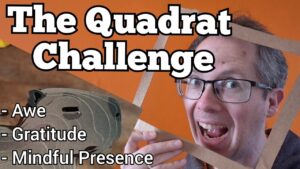
This is the Quadrat Challenge: Looking at the small for Mindful Presence, Gratitude and Awe.
In this article, I will cover what the challenge is, how you can do it, and I’ll talk more about the positive psychology of how observing a small patch of ground can help you with your mental well-being.
Contents
What is the Quadrat Challenge?
A quadrat is a tool used in ecology to sample a patch of land. Let’s say I went into the garden, and I was trying to work out the biodiversity, rather than trying to count the entire garden, I would pop a quadrat down, measuring the flora in that quadrat and use some fancy maths and a couple of samples to extrapolate how many plants there are in the whole garden.
You’ll be pleased to hear that this challenge involves no maths – in fact, the whole idea is to be more observant and less cognitive.
I named it the Quadrat Challenge because I like the idea of sampling our surroundings as an observer – being a mindful scientist.
How to do it
To do this challenge, all you need is a frame or what I’m calling a quadrat. I made mine by simply cutting out a cereal box or using other bits of cardboard.
You’re then going to chuck it somewhere random in your house and spend time just being attentive to whatever is inside of that quadrat.
The square is a small patch that you probably normally walk by and don’t pay much attention to and the challenge is instead giving it focus:
– Cognitively: thinking about what it’s used for and being aware of any memories that parts of it ignite in you.
– Observing: paying attention to everything that you can find within this square.
– Sensing: engaging the senses, how different parts feel, look, even smell.
– Meaning making: in noticing any reflections that might come out
– Somatically, being attentive to your inner world of sensations in the body and feelings in response to doing this challenge.
You may even experience some of that positive psychology, being in the moment and realizing just how vast the world beneath you is.
Example
Positive Psychology
This is psychology focussed on cultivating positive emotions from interventions, rather than trying to reduce negative ones, and in the rest of this article, I’m going to look at Awe, Gratitude, and Mindful Presence.
Awe
Outside of religion, Awe is a word that isn’t likely to come up in your vocabulary. You may however say Awesome to say something that is awe-inspiring and positive, and we also have the word Awful that more conveys the fear that can come alongside awe.
What is Awe?
Awe is an emotion that’s distinct from other feelings like fear or excitement, joy or peace, although it may contain elements of all of those.
Awe is also a psychological state that we can enter.
Vast
Awe is experienced in response to situations that are firstly vast where we have a smaller sense of self.
An example might be walking by a mountain, and realising just how small and insignificant you are. Nature’s vastness comes from its size, its scope, complexity, and power. And in that sense, it’s awe inspiring.
There are other things that can inspire awe as well:
– Spiritual practices like prayer or meditation
-Creative arts like being struck by the beauty of a painting.
– Collective group activities like rituals, dance or music, for example, that moment of euphoria when you’re part of a crowd at a music gig.
– Beginning to grasp our insignificance; e.g. if you watch a video on the size of the universe and realize just how small we are.
– Psychedelic experiences like ego death.
– Coming face to face with the wonders of either birth or death
– When you’re part of some kind of group and you hear other people’s stories, their lives really touching you.
– The vastness of a Quadrat Challenge. There’s a sense of awe that can potentially come from realizing just how huge and complicated the world is just within a small randomly placed frame.
Cognitive Schema shifts
Cognitive Schemas are the way you think about the world yourself and how that impacts on how you behave. Awe experiences can change you. Experiencing awe feels quite profound, often with positive emotions like peace. You may experience goosebumps. You might even say, “Wow,” like when you’re watching fireworks. Physically It lowers inflammation.
The Default Mode Network (DMN) are the parts of the brain we use for introspective thinking like daydreaming, contemplating the past or future, and focusing on ourselves including that pesky self-criticism. These regions of the brain in the DMN are very useful and necessary to our survival, but too much activity can lead to an amplified sense of self. And an amplified sense of self is associated with a whole host of difficulties like:
– depression
– anxiety
– rumination
– body image issues
– self harm
– eating disorders
-addiction
Awe experiences reduce this DMN activity and this can shift our perspective from introspection to observation. It moves our thoughts and feelings from our internal world to the external. And this can work wonders to combat those mental health holes we can so easily get stuck in.
Awe as Therapy
Awe walks like in a woodland have been used as mental health treatments. we begin to experience more present moment awareness and time might even start to feel like it’s going slower which can be a wonderful break from our busy, sometimes self-critical, and difficult minds.
Meaning-Making
We’re observing rather than just hearing our inner narrative, we can start meaning making by reducing DMN activity. Our rigid negative thought patterns are more flexible. We’re reflective rather than ruminating. We are freer rather than relying on internalized scripts. And we can be critical without our ego being affected. Awe can expand our worldview accommodating new information which can help lead towards personal growth and reduce distress and depression as we align more closely with our values.
Prosocial
So, it turns out that being highly introspective with that increased DMN activity and an Amplified Sense of Self can make us quite rigid. and rigidity means that people who are different to us are quite threatening. We’re stuck in our head. We’re ruminating. We are rigidly clinging to our self-concept. We have an amplified sense of self, and that’s associated with social problems such as bullying and discrimination which can risk something utterly terrible for our health: loneliness. Loneliness is reported to be as bad for us as smoking 15 cigarettes a day.
Awe experiences can improve that & are seen as pro-social. In having more awe experiences, we’re likely to be more generous, cooperative, and better able to connect with other people. Difference will be seen as less of a threat. We’ll be able to see the common humanity in others and have an enhanced ability to take other people’s perspectives outside of our small selves.
This difference is even physical. We start producing more oxytocin, which you may have heard described as the ‘love hormone’. And understandably, this greatly improves our well-being and can even boost our life expectancy.
Summary
So that’s Awe: a human emotion in response to something vast that changes our cognitive schemers, allows us to make meaning in life and is pro-social.
Trauma is a little bit like a villain, making us re-evaluate our life in response to huge trauma information. And awe is a bit like the hero, doing the same thing, helping us to re-evaluate our life again in response to something outside of ourselves.
If you want to experience or then really going out in nature that ‘wows’ you is your best bet, but the quadrat challenge really has potential to emphasize the vastness of the world, which could mirror some Awe experiences. The challenge is possibly more similar to wonder or astonishment, but I think it could definitely be considered as Awe-light.
Gratitude
Gratitude is one of the most researched topics in positive psychology but defining it can be quite difficult and most of papers seem to define it differently. It’s been described as a feeling, a personality trait, a moral virtue, a discipline, an attitude, habits, intervention, or a coping response. You can be grateful for people, things or circumstances in life.
I would like to define gratitude as bringing into our awareness something or someone that is benefiting us and then focusing on being grateful for that person or thing (whether you experience that feeling more emotionally or in other ways is semantics).
Why Gratitude Works
Although there is some debate, gratitude seems to consistently have a small effect on well-being. And here are some of the theories as to why that might be:
– We’re evolved as problem solvers, and that’s essential for our survival. But in our modern world, being problem-focused and living that way is all a little bit overwhelming and can mean that we overlook the positives.
– Many common mental health problems too like depression and anxiety get us stuck in a negative mindset where we can struggle to see those positives in our own lives.
– Cognitive Distortions like catastrophizing, negativity bias, discounting the positives, rumination, and ‘mental time travel’ all weigh our mind towards negativity.
– Helping with group cohesion: we are a very social animal with a tribe needing us to be united.
Gratitude is what we call a Compensating Response to reprogram negativity, training the brain to become more positive, and out of those negative ruminating thought patterns towards glimmers of gratitude (even in the midst of quite difficult situations). The resulting gratitude then helps us to build social connections, which also help with our well-being.
Studies
In 2023, Diniz et al, looked at 64 randomly controlled trials in a meta-review which looked at the impact of different gratitude interventions on mental well-being compared to a control group. This meta-analysis showed that gratitude interventions:
– improved gratitude by 3.42 to 5.7% relative to the control group.
– increased life satisfaction by 6.86%
– mental health scores by 5.8%
– decreased depression scores by 6.89%
– decreased anxiety scores by 7.76% on the GAD-7 questionnaire.
The group that had the gratitude interventions were generally more optimistic, appreciative, in a better mood, had more pro-social behaviours, felt less pain, and were less worried.
Generally, it seems that this study and several other meta reviews found that gratitude interventions improve your welfare. Not by a huge amount, about 5%, but they’re reasonably easy to do and tend to make people feel slightly better.
Though, as Kerry, points out in their meta-analysis that might be partly due to self-reporting placebo or because the control group aren’t getting that many interventions full stop.
There was also a study in 2022 by Regan et al, working with 958 Australians and putting them into four groups: gratitude letter writing for people, letter writing for things, gratitude list writing for people, list writing for things, then two control groups.
There weren’t huge differences, but there were two things that are useful to bear in mind from that study:
> Generally the letters did slightly better than the lists: the thought behind that is that if you’re really engaged with the gratitude, you get more from it than if you just simply name things you are grateful for.
> These gains seem to drop off on follow-up a week later. And the author takes from that, that gratitude isn’t a one-time fix, but more of a discipline that would be needed to maintain to keep up the benefits.
Quadrat Challenge & Gratitude
The quadrat challenge brings into awareness the vastness of a small patch which you may have previously overlooked. In noticing it, there’s opportunity to be grateful for its presence in a way that is deeper than simply saying, “I’m grateful that I have a home.” In the example, we engage with a small patch of carpet and might feel additionally aware of and grateful for memories in the house spurred from that patch of carpet. In the same way that writing a letter was a slightly better Gratitude Intervention than simply listing things we’re grateful for, engaging deeply with that space inside of a quadrat may make us more thankful than simply saying, “We’re glad we have a carpet.”
What the challenge is really doing is creating awareness of things so that positive impacts of those things can be acknowledged. But it’s important to note that the gains from gratitude, even if we were to be writing a targeted letter at someone we appreciate, are quite small (about 5%), but still significant.
Mindful Presence
When I say mindful presence, I mean being a non-judgmentally aware observer of a present moment – and that incorporates a lot of principles from mindfulness.
If you watch my last video on doing mindfulness after you stub your toe, you’ll remember that mindfulness is a lot more than just meditation. In fact, the five facet model breaks mindfulness down into five facets.
5 Facet Model of Mindfulness
- Observing both the internal and the external.
- Being able to describe our experience with language.
- Acting with awareness and behaving in ways that are attentive to the present moment.
- Non-judgment of experiences, especially those inner experiences.
- Non-reactivity to experiences, particularly inner experiences.
Meditation improves all those facets, but meditation isn’t the only way to be mindful. Doing the quadrat challenge can be mindful in that we are
1. observing what’s within the quadrat
2. We are describing it in language if making content on it
3. we are trying to be extra attentive to thoughts that come up, any sensations as we touch those things, or to what we see.
4-5. Trying not to be too judgmental or reactive.
It’s about being a curious observer of the quadrat.
Studies
There have been loads of studies which have shown a positive impact to our mental health and well-being of mindfulness. But I’m going to talk about two studies that focus on differentiating mindfulness and presence.
Johnson et al, 2024
1,600 Canadian participants did the Five Facet Questionnaire which split them into five different profiles of people: High, Moderate, or Low in mindfulness; Non-Judgmentally Aware profiles, and Judgmentally Observing profiles.
Those in the High Mindfulness reported the best life satisfaction, existential well-being, and mental health (as expected).
But the Non-Judgmentally Aware profile group actually had similar levels of both life satisfaction and existential well-being as well as similar low levels of anxiety and stress.
It was the second highest scoring category.
What this study indicates is that cultivating an attitude of Non-Judgmental Awareness can reap similar benefits to being highly mindful for our mental health and well-being.
Kiken et al, 2017
This study differentiated mindfulness from Savouring the Moment: Savouring the moment being about responding to positive experiences and trying to enhance them, and mindfulness being about observing whatever is going on in the present moment without judgment.
They questioned 89 people over 40 days to assess their disposition towards mindfulness and their ability to savour the moment.
From those surveys (small sample size), they found that Savouring the Moment significantly predicted about 12% of the between-person variance in daily reports of positive emotions.
They suggest a mechanism where it’s savouring the moment rather than mindfulness that helps predict higher levels of positive emotions and so increases psychological health. However, savouring the moment has a moderate significant relationship with how dispositional you are towards mindfulness. I.e. doing mindfulness helps you to Savour the Moment which creates positive emotions (even if there’s a lot of negative emotions in your life), and helps to improve your psychological health.
Mindful Presence Summary
What I’m saying from these studies, and this maybe reflects things like flow, is that there are an awful lot of benefits from being present and aware and in-the-moment. That may look like meditation, but it can also look like doing activities, particularly activities where we’re not judging the thoughts, feelings and sensations we are experiencing in response to what we are experiencing.
In doing activities which promote dispositional mindfulness, savouring the moment, and non-judgmental awareness; there can be a feedback loop where those things become easier which in turns impacts on our well-being and positive emotions.
Quadrat Challenge and Mindful Presence
Mindful presence could have a small but significant improvement in your life (we’re talking 12%).
The Quadrat Challenge definitely isn’t the optimal way to be mindfully present, appreciating the moment, & savouring every positive aspect of it; but I think it achieves it to an extent.
You are being present in the moment. You are being an observer of what is there in front of you. And you’re not being a judge: it’s a sense of leaving your head to experiment and to look at what’s in front of you.
Conclusion
We introduced the Quadrat Challenge and looked at some papers to talk about the psychological benefits of Awe, Gratitude, and Mindful Presence.
The Quadrat Challenge is not a recognized mental health intervention, so understandably, there are no papers on whether or not it has efficacy at helping us to be more of any of those things or of treating mental health and wellbeing. However, we do discuss how it could have glimmers of an awe experience (maybe more wonder, curiosity or astonishment), how it may be able to help with gratitude in the sense of engaging with things that we are particularly grateful for, and it may be even stronger as a way of building mindful presence. Seeing as those three things are all associated with positive psychology, the quadrat challenge will probably help you feel a little bit better. And at best, we are talking somewhere between 5 -12%. But it might cultivate an attitude of being mindfully aware and looking out for other or experiences outside of a tiny cube in your household.
There are some other benefits to this thing which I didn’t discuss.
– a break from screens
– We’re doing something different which adds novelty and can help with presence.
– it’s dull & mundane, a little bit boring staring at a tiny quadrat on our carpet, and learning to tolerate boredom is a necessary skill in a stimulating world that avoids it.
– celebrating dull things also recognises that all aspects of your life deserve recognition (not just the milestones we usually see on socials).
– there’s unlikely to be much risk to doing it
Outro
Do have a go at the quadrat challenge yourself. It’s relatively easy to make a frame. And feel free to post something on it. If you do, feel free to tag me. I am Simon’s listening on YouTube, Simon’s Listening on Tik Tok, and on Facebook I’m Simon’s Listening Counselling Services. I would be fascinated to hear about the mundane aspects of your life, about the tiny squares in your in your house, and to see the joy and the excitement and the presence that comes out of engaging with that.
References
Mindful Presence References
Johnson, NJ; Smith, RJ; Kil, H. (2024). Not all mindfulness is equal: certain facets of mindfulness have important implications for well-being and mental health across the lifespan. Frontiers in Psychology. Vol 15.
https://www.frontiersin.org/journals/psychology/articles/10.3389/fpsyg.2024.1347487/full
Kiken, LG; Bundberg, KB; Fredricksen, BL. (2017). Being present and enjoying it: Dispositional mindfulness and savoring the moment are distinct, interactive predictors of positive emotions and psychological health. Mindfulness (NY). 8(5). Pp1280-90
Gratitude References
Diniz, G; Korkes, L; Tristao, LS; Pelegrini, R; Bellodi, PL; Bernado, WM. (2023). The effects of gratitude interventions: a systematic review and meta-analysis. Einstein (Sao Paulo). July.
https://pmc.ncbi.nlm.nih.gov/articles/PMC10393216/
Kerry, N; Chhabra, R; Clifton, JDW. (2023). Being Thankful for What You Have: A Systematic Review of Evidence for the Effect of Gratitude on Life Satisfaction. Psychology Research and Behaviour Management.
https://pmc.ncbi.nlm.nih.gov/articles/PMC10693196/
Regan, A; Walsh, LC; Lyubomirsky, S. (2022). Are Some Ways of Expressing Gratitude More Beneficial Than Others? Results From a Randomized Controlled Experiment. Affect Sci. 4(1). Pp72-81
https://pmc.ncbi.nlm.nih.gov/articles/PMC10104980
Sansone, RA; Sansone, LA. (2010). Gratitude and Well Being. Psychiatry. 7(11).
https://pmc.ncbi.nlm.nih.gov/articles/PMC3010965/
Awe References
Hercz, Dr G. (2025). Awe as Therapy. https://psychonephrology.com/awe-as-therapy/
Monroy, M; Keltner, D. (2022). Awe as a Pathway to Mental and Physical Health. Perspect Psychol Sci. 18(2). Pp309-20.
https://pmc.ncbi.nlm.nih.gov/articles/PMC10018061/
Sepanta, AMM. (2025). Expanding the Self and Enriching the Mind: The Remarkable Role of Awe in Mental Health. https://mindfulspark.org/2025/01/23/expanding-the-self-and-enriching-the-mind-the-remarkable-role-of-awe-in-mental-health/

Simon is a Person-Centred Counsellor in Oxford working remotely and in person. He has lived in the county his whole life, and the city for almost 20 years. He appreciates the beauty of the city, nature, and connecting with people to help bring about meaningful change.
He is also a geek – who gets tremendous joy from gaming, crafting, cosplay, and creativity