
Mindfulness for Toe Stubbers
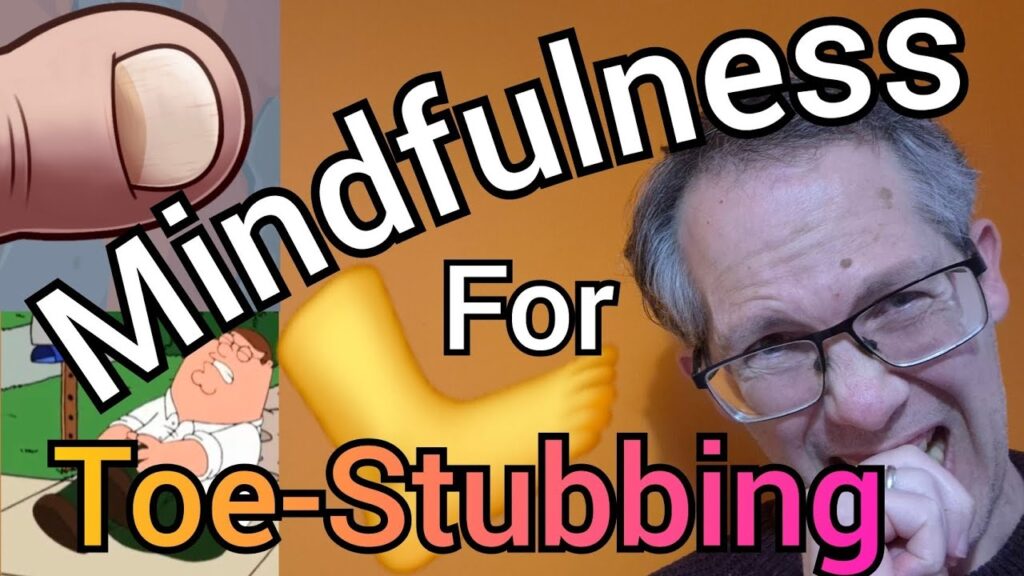
This is using mindfulness for when you stub your toe – an alternate way to respond to physical pain and you can use the same principles for emotional and psychological pain.
Contents
Automatic Reaction to Toe Stubbing
Hopping around, grabbing your toe, swearing – these are all automatic, natural, and even helpful responses to the pain of stubbing your toe.
Reflex Response
When you stub your toe, you automatically pull the foot away from the obstacle e.g. a table leg. This is an automatic reaction that we’ve evolve to do and pre-dates our thinking brain to instead use the spine.
Imagine you’re cooking. There’s a pan on a hot flame heating up rapidly. Without thinking, you touch the pan and it scolds your hand. Your fingers are in danger, you don’t want to be contemplating whether you should or shouldn’t take them away, you want to automatically pull back from the pain in a fraction of a second.
The physiology of this withdrawal reflex is quite clever. You’re not thinking about withdrawing your hand at all – considering whether it’s wise or not to take our hand away with the signal going all the way to our frontal lobe.
Rather, in a flash, the pain signal goes from our burnt hand to our spinal cord and then back again to pull away. Damaged, mitigated, it the reflex hasn’t even interacted with the brain. We can process what happened later.
Likewise, withdrawing your foot after stubbing it is an automatic reflex response to the danger of a table leg. You’re not wrong for hopping about.
Swearing
Swearing has been shown to significantly help with managing pain and we’re not quite sure why – it’s deeper than just distracting ourselves from the pain or expressing feelings associated with pain, and somehow reduces it – especially if we’re not used to vulgar language.
A study in 2020 by Stephens and Robertson was looking at the effects of swearing on pain tolerance.
They got 92 participants to put their hand into icy cold water, and they do this four times measuring how long before it hurt (pain threshold) and how long they could keep it in the water for (pain tolerance):
1. Using a swear word, Fuck
2. The made-up swear word, Fouch, which was seen as emotionally expressive.
3. The made-up swear word, Twizpipe which was seen as distracting or humorous.
4. A Control Word (something participants chose that describes a table e.g. solid)
So these 92 participants had to repeat that word every 3 seconds in a calm voice and say when they first felt pain & then they measured how long they were able to keep their hand in the icy water.
The results were that neither made-up swear word was significantly different to the neutral word at increasing either your pain tolerance or your pain threshold (though the words were rated as humorous/distracting or emotionally evocative)
Fuck, on the other hand, did have statistically significant results. It increased Pain Threshold (how long it takes for the water to actually start hurting) by 32% and Pain Tolerance (how long you can keep your hand in the cold water) by 33%.
So Swearing really helps with pain tolerance and we don’t quite know why. It’s more than distraction or expressing feeling.
Automatic Conclusion
The natural automatic response to acute pain from stubbing your toe by trying to withdraw the foot for safety, sooth it by hopping or holding the toe, and cathartically swearing is fine/automatic/effective and totally okay and normal.
Mindfulness
When I say mindfulness, you may picture someone sat cross-legged in the lotus position with their arms out saying some kind of Buddhist mantra. This is an example of mindfulness, but mindfulness can be so much more than just sitting meditations quietly – it can be quite active, for example:
– Going for a walk and paying careful attention to the footsteps
– Being aware of the sensations as you brush your teeth.
– Focusing on your breathing as you’re getting ready to fall asleep.
– A 10-minute meditation bringing into conscious awareness the entire experience of eating a single raisin
– Or even, stubbing your toe as a mindful response to pain.
Mindfulness is bringing the present moment into conscious awareness – whether that be meditating in stillness or doing activity.
Mindfulness practice usually begins focused on the sensations that are going on in the body because sensations are always in the present moment, so make a good anchor. It’s why mindful practice usually begins with observing the breath.
A therapeutic benefit of mindfulness, is that rather than being led by those sensations, we become an observer of them. We notice them sensations, and as we practice can extend this to noticing thoughts, our inner narrative, feelings, behaviours, and even pain rather than overly identifying with it or judging it as good or bad.
There are various 8 week Mindfulness-Based CBT programs that start off with simple sitting meditations, but come Week 3, you’ll be doing mindful stretches, which practically means holding uncomfortable positions that may even give you cramp and turning towards pain and discomfort. It’s quite different to that reflex response that makes us want to withdraw from pain rather than paying mindful attention as an observer of it.
Mindful Toe Stubbing Practice
If you do withdraw, swear, or jump around, it’s okay – It’s a instinct. The body’s just trying to protect itself. You’re doing nothing wrong. Just acknowledge that you’ve been avoiding pain and switch to this new way of processing. Likewise, if at any point, you find yourself distracted by the sensation of pain, thoughts, or feelings like panic – that too is okay, just gentle acknowledge it and return to mindfully observing the experience of the stubbed toe.
I want you to pay very careful attention to the sensations that are going on in your toe. Try not to judge it as good or bad, avoid labelling anything. Just be really interested in sensations. Perhaps there’s a sensation of pain. What are the qualities of that pain like? Is there a throbbing sensation, or perhaps it is stabbing? Perhaps there’s a warmth, a feeling of heat in the place where you’ve banged it. Is the pain in one place or does it radiate to other toes? How loud or intense is that feeling of pain?
Just really take some time to notice and describe the pain you are experiencing in the stubbed tow.
Whilst still being aware of the pain (as an observer), pay attention to the appearance of the toe. What do you notice about the form of the foot, the way the digits appear to you? Maybe it’s odd, strange, or funny looking at the toes. It’s okay if the mind’s wondering to judge this exercise and think about how odd it is. But bring your attention back and just observe the toe that you stubbed. Maybe there’s some redness there. Perhaps you really kicked it hard and it’s bleeding slightly. Notice the stubbed toe. Look at it.
Now that you have a really good awareness of the sensations in the toe that you stubbed, maybe extending that to sensations in the foot (as a whole), whilst keep the toe in awareness. Your stubbed toe may be the part of the body that is most crying out for attention, but the toe is only one part of the body, only one part of the foot, only one part of the leg, only one limb. We have four other limbs. And there are sensations that are going on with all of them that can easily be drowned out by pain in one part. Perhaps scanning the body and being mindfully aware of everything that’s going on within it that puts the toe pain in perspective – makes it smaller.
Start to become aware of any thoughts that are beginning to arise. Perhaps thoughts of judgment on how uncomfortable and unpleasant this experience of stubbing your toe is. A desire to avoid the pain and move away from discomfort. Maybe you can hear yourself wanting to swear the words almost forming in the lips whilst being an accepting observer of those thoughts.
Notice too any feelings that might be arising within you. Maybe your thoughts are racing: you’re feeling shocked or starting to panic in response to the pain. Maybe there’s a feeling of sadness because of this pain: you may notice that you almost would like to cry and feel that gathering in the eyes. You may feel angry: this might be pushing you to want to shout or stomp about. There may even be a frustration or boredom from doing this mindful practice. Whatever feelings are there, just observing and allowing them. They don’t define us. They’re just feelings. Just like thoughts are just thoughts. They come and go. Be an observer and notice them as they arise within you.
And now bringing the attention back to the foot. Noticing the quality of pain that was there before and whether that has shifted. Maybe it’s improved. Maybe it’s got worse. There’s no aim in this practice – we aren’t using it as a technique to make the pain go (even though it often does in doing this) – we’re simply trying to change our relationship with pain: going from reacting to pain, to observing it.
You can carry on this mindfulness for toe stubbing meditation as long as you’d like to. Continuing to turn towards discomfort, breathing into it, noticing it, not trying to change anything; just non-judgmental, acceptant observation, putting the pain in perspective compared to the whole rest of your present moment awareness.
Conclusion
This video may have come across as a bit strange, just like some of my other videos
Understanding Bereavement form Being Locked in the Toilet
Using a Hot Cross Bun (or Traffic Lights) for Self-Awareness.
But there’s really an awful lot of powerful application from this. This video was teaching us to become an observer of things rather than trying to push away discomfort or pain.
People often come to counselling because of pain or discomfort in their lives, and a counsellor can help you to be present with and tolerate pain – which is exactly what we’re doing here within the microcosm of a stubbed toe.
In the practice, we used present moment observational non-judgmental acceptant awareness of a sensation of stubbing our toes and using the sensation of pain to anchor mindful practice. Ironically, by being present with things that are uncomfortable and painful, whether that pain is psychological, emotional, or physical; can actually help to alleviate it somehow.
As an example, I have tinnitus: the more I try and ignore it and push it away, the more I focus on it and hate it, the more power it has. Allow yourself to be an observer of pain, rather than having it controlling or distressing us, alleviates it and changes our relationship with it.
You may be interested in two other videos on my YouTube channel.
One is a 10-Minute Sleep Meditation by Nikki from Nikki Mason Wellbeing
The other is a discussion on Mindfulness for ADHD, a podcast interview I did with Leizl Laidlaw from Rewire Therapy.
Simon is a Person-Centred Counsellor in Oxford working remotely and in person. He has lived in the county his whole life, and the city for almost 20 years. He appreciates the beauty of the city, nature, and connecting with people to help bring about meaningful change.
He is also a geek – who gets tremendous joy from gaming, crafting, cosplay, and creativity