
Behaviour Chain Analysis
Yet again, you’ve lapsed. You’ve lost count how many times you’ve been here before, you’ve lapsed, binged, used….You sit there full of self-loathing and shame and wondered to yourself, how did this happen? What caused this? Why am I so powerless over my addiction? There’s a hopelessness after a period of sobriety and you don’t really see how abstinence would make sense, how it would work for you.
That’s where this article comes in. This video is teaching the DBT skill of Behavioural Chain Analysis. By the end of this article you’ll have learned a skill that you can use to gain some agency & understanding over a lapse, the steps that led up to it, what contributed to those steps, how to change things in the future so you’re less likely to go down that well-trodden neural pathway, and also how to be able to somewhat make amends and sweep up the carnage left as a result of that lapse.
Contents
Intro
This is the second article on our series on DBT for Addiction, which you can listen to in any order. I’ve usually taught multiple skills in these articles, but Chaining is so helpful it needed its own dedicated one. It’s useful to have a tool we can use to combat the shame and helplessness that so often follows a lapse.
I may be mostly speaking about a lapse into substances misuse like drugs or alcohol, but this skill is useful for addressing any lapse on a Targeted Behaviour (Self-Harm, Suicide Attempts, Pornography Use, Binge Eating, Bulimia, Gambling, Smoking, Compulsive Gaming or any other behaviour you are trying to stop but often relapse into).
DBT
Dialectical Behavioural Therapy (DBT) was developed in the late 80s by Marsha Linehan. It is a skills-based approach to working with people who have been exposed to developmental traumas in childhood, targeted at self-injurious or impulsive behaviours (specifically, originally, suicide). It was originally made for treating Borderline Personality Disorder (BPD) and is an evidence-based treatment for this.
Like the developmental trauma that characterises BPD, people with addiction issues have also commonly experienced developmental trauma and Adverse Childhood Experiences (ACEs), and the addiction is often a solution for coping given that.
So we need to step away from any sense of blame you may feel towards others stuck in addiction, or yourself if you have a tendency towards compulsive behaviour. We need to validate that the substance or behaviour is you coping the best you can with what you’ve got, and it’s not your fault you are an addict (why would anyone choose that?).
Alongside acceptance and validation of addiction, we also need to balance that with it being your responsibility to take ownership of this ineffective behaviour. To learn skills, get support, and look to change – which hopefully this article can help with.
Intro to Behaviour Chain Analysis
When we have lapsed into a Target Behaviour (like drinking) chaining breaks down the specific steps that led up to that lapse, contributing factors that make us vulnerable, and the consequences of what happened after. It breaks it down into steps and at each step we are thinking if there is any alternate behaviour, or skill, we could have used that would have had a different result and then considering what the weakest point in the chain is that we could change. The idea isn’t to shame us or to ruminate on what happened before. It’s to think about steps that we could take in the future to have more control and awareness of what might predispose us to risk of relapse. Doing BCA will build awareness, control, insight, and the potential to effectively make amends.
Easier Version of Behavioural Chain Analysis
This version is easier to conceptualise and useful for going through with a sponsor. Effectively you’re just thinking of what led up to a lapse, and what you could have done instead at each link in the chain for next time. If you’ve ever done a Relapse Prevention Plan, you’ll likely notice similarities as Chaining is the foundation of these plans.
I want you to imagine that you have relapsed on an Ineffective Target Behaviour (you’ve had a drink). You feel shame but are trying to reflect on what happened so that you can change it future. This is where BCA comes in.
Step 1: Come up with the links in your Chain
You’ll need a piece of paper or a note app on your phone. Spend 10-15 minutes writing down the events that led up to the lapse. Break it down into small steps of what happened that day which led to a chain of other steps resulting in the lapse. Do this in whatever way best suits your brain – you may want to start at the beginning of the day and work forwards, or backwards from the lapse itself.
Step 1 Example
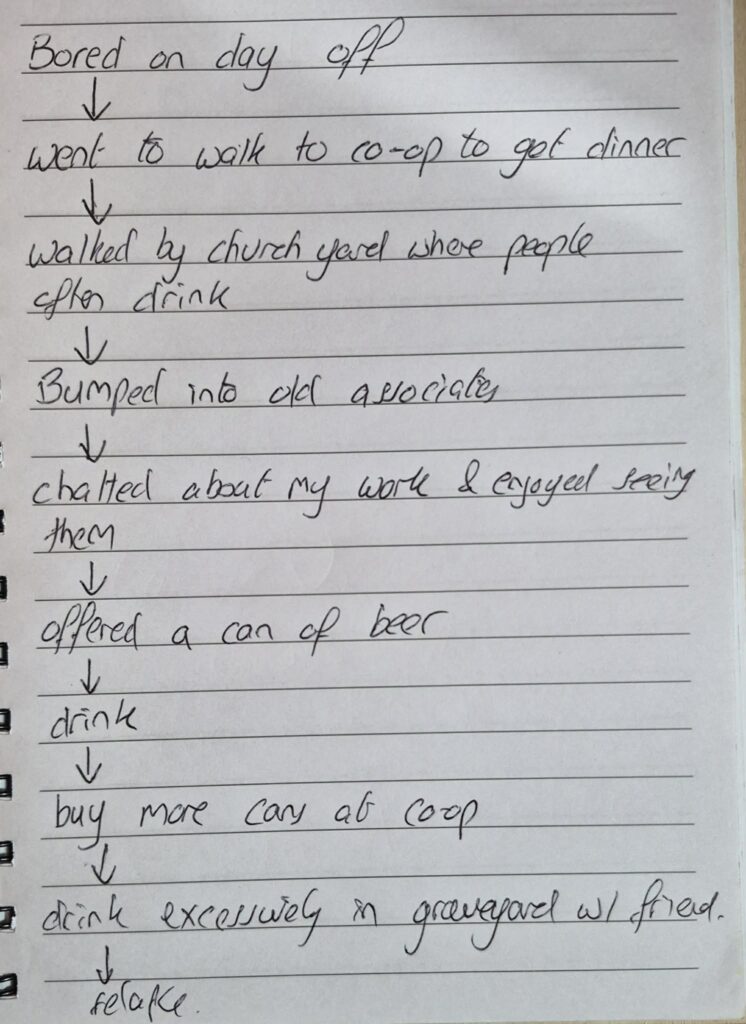
Imagine it’s your day off and you’re bored – you’ve done the usual things and it’s not quite hitting your interests.
You feel hunger and realise you’ve not got dinner sorted, so decide you best go to the shop and decide to buy a frozen pizza.
You make your way over to the shop to get yourself dinner, and on the way, you walk by the churchyard (a place where a lot of people hang out to drink and score drugs, and where you used to use)
You recognize a couple of people as you walk by them. You see them drinking in the in the churchyard. And you think to yourself, “it’s been a while, I’m going to say ‘hello’” – discounting the risk of this and assuming you’re doing well and will be okay.
You get chatting to them, going back to using their street names, and it’s actually quite nice to catch up. You enjoy yourself, sitting down for a bit and have a laugh.
One of them offers you a beer
You think about it a bit, but you’ve got 6 months clean time and decide you’ll probably be okay with the one
You have a drink, and as the alcohol passes through your body you find that obsession coming over you, as old neural pathways from your Addict Mind scream out.
You reach the shop, but decide against the frozen pizza. Instead you get a meal deal to eat, and buy a crate of beers.
You return to the graveyard and get totally pissed, sharing the beers with your old mates, and relapse into a bender of drinking.
Step 2: Alternate Skilful Behaviours
The second step in our basic version of BCA is to look at each link in the chain and to think about an alternate activity or a skill that you could use instead of the chain which led towards your relapse. This might be using a DBT skill, problem solving, recovery skills, or just a different decision that would have changed the outcome.
Step 2 Example
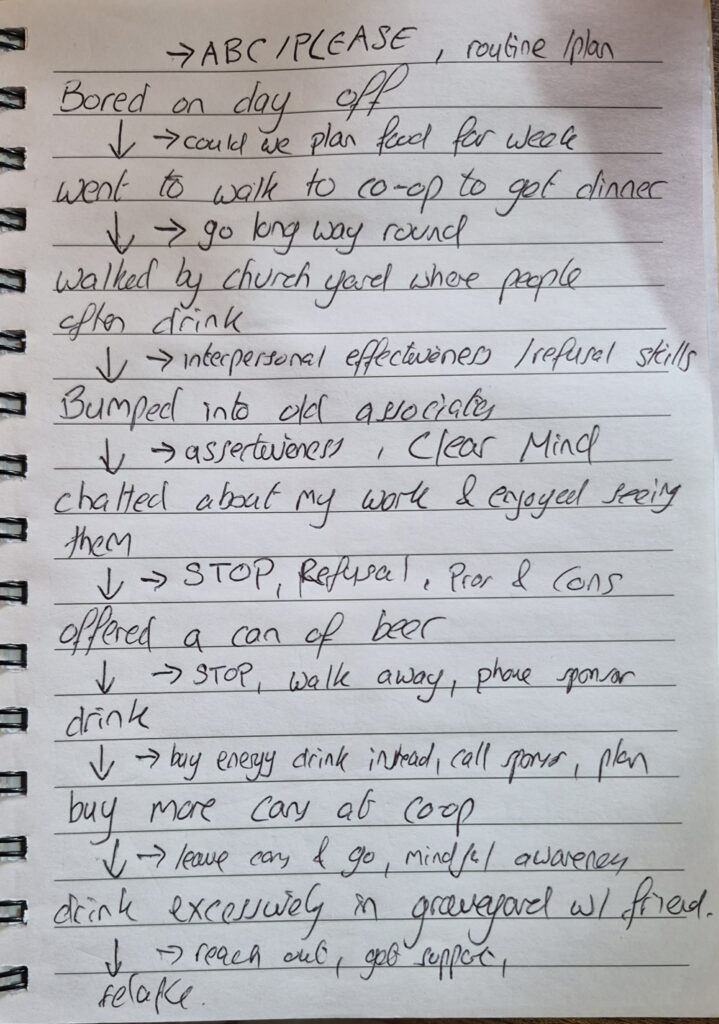
Instead of the boredom and hunger that started the chain, could we use the ABC PlEASE Skill?
Consider our routine of activities, what we’re doing for purpose in life, how our general wellbeing & life skills are, meeting our social needs (the example sounded slightly lonely?). Shifting this could completely change the prompting event that led to the chain.
Instead we had no food in so went to the shop for a pizza. Could we instead plan our food for the week. If we did need to go to the shop, could we walk the long way there to avoid the cemetery (even if it’s an extra kilometre, we’re bored anyway)? Going the long way round would utilise that skill of Bridge Burning covered in the last article.
We don’t, we go to the graveyard, and see people we used to know drinking there. Can we use some of the skills from the interpersonal effective module? Can we use some Refusal Skills that we’ve picked up in rehab to just outright avoid talking to those people who we know are still in active addiction?
Instead we go to the next stage and chat with them. Could we use the Clear Mind skill from the last video to recognise how risky this is – we are not recovered, we’re an addict at high risk of relapse. Could we use assertiveness skills to keep the conversation to a minimum or at least overtly set boundaries that we’re not drinking. There’s a saying in AA that ‘if you go to the barbers enough, eventually you’re going to get a haircut’. If you hang out in the churchyard where everyone drinks, eventually you’re quite likely to have a drink.
We do chat with them, it’s nice, and we’re offered we’re offered a can of beer.
Instead, could we could we use the STOP Skill? I’ll cover it in another article, but it’s what it says on the tin – stopping to consider what we’re doing and creating distance so we can respond soberly rather than compulsively to our addiction.
Could we use refusal skills? Some Pros & Cons in our head (not a full written Cost-Benefit Analysis) – just consider the consequences of having a beer?
We don’t do that though; we have a drink. Is there anything we can change at this point? Could we instead call our sponsor? Could we go back home due to the risk of buying more booze at the shop, or go to KFC and get dinner there because we know they don’t sell alcohol.
Instead we go to the shop that sells frozen pizzas (and booze). Could we use Harm Minimisation to buy an alternate like a big can of energy drink or alcohol-free beer? Can we use bridge burning to avoid the alcohol aisle altogether. Could we use mindfulness to create awareness of what we’re doing and just Push Away and STOP.
Instead we buy the crate and return to the graveyard. Anything we can do at this stage? Could we just give them the crate and leave, could we sabotage our drinking by dropping the bottles so they all smash. Could we reach out for support, like calling our Sponsor?
Instead we binge drink which leads to a full relapse. Again, anything we can do here? Any recovery services we can reach out to or a meeting we can go to. Can we practice Distress Tolerance skills like TIPP to ease the shame enough to reach out for help?
Step 3: Weakest Link
We’ve done the chain and have a good idea of both the events that led up to the relapse, as well as alternate behaviour that could have changed the outcome.
The next stage is to think about which of those points was the weakest point in the chain. If pulled a paper chain apart, It wouldn’t be the whole thing that snapped, it would be one or two links in the chain, and the third stage is thinking what the weakest links are so that we can break that chain from building next time (BTA is always about next time – it empowers rather than shaming).
Step 3 Example
I would suggest the easiest link to break which would change the whole outcome would simply be to walk the long way round to avoid walking to the church, or to have worked on your routine so you weren’t likely to be bored at home, or to have gone shopping for the whole week so you weren’t thinking ‘I’ve got nothing in’. When we’re hungry our willpower is likely to be low, so that seems simplest to fix.
Summary
So that’s it. That’s the basic version. If you remember nothing else, just remember to write down a chain of events leading to the lapse and how you could alter each step. Don’t let this shame you, it’s exploring the lapse to empower your recovery for the next time you encounter that situation.
Full Version of Behavioural Chain Analysis
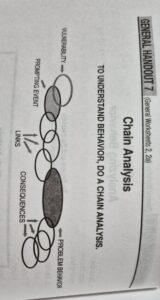
This more advanced version is taken from the DBT Workbook (by Marsha Linehan), general handouts 7 and 7a.
It uses the links in the simpler version but has more enquiry and also adds some extra stages:
Vulnerability Factors (what predisposed you to starting the chain)
Prompting Event (the Trigger that started it)
The Links (stages from the simple version)
Problem Behaviour (the lapse itself)
Consequences (the impact on you and others from the lapse)
Below are the stages the workbook describes in order:
1. Describe The Problem Behaviour
Name that you are experiencing an urge or craving to return to addictive behaviours or substances. Be specific about where the urge wants to take you, and how you experience it. Urges are perfectly natural and part of addiction to want to return to a coping mechanism that has worked for you in the past to regulate. Having an urge doesn’t mean you have lapsed or are in any way failing in your recovery.
2. Describe the Prompting Event
Describe the Prompting Event in vivid detail. In Recovery, you may have heard Prompting Events called Trigger – the thing that triggered the chain of events that led to the lapse. In our example from the simpler BCA, the prompting event was probably going to the graveyard, or you could backtrack more to the boredom. A Prompting Event is something in your environment which started off this whole chain of events which led to the lapse. Again, consider the thoughts and imagery in your mind during the Trigger. What were you feeling, any behavioural cues that this would unfold? Why on that day and not another?
3. Vulnerability Factors
What weakened your resilience and meant you were more likely to be triggered.
In DBT, this is very much the PlEASE Skill (untreated injury or health issues, exercise, addictive substance misuse for example if you’re not taking your medication correctly, your sleep hygiene, and getting regular exercise).
In Recovery, you may have heard the HALT Acronym (Hungry, Angry, Lonely, Tired). Any of those might motivate a lapse or for you to stray from your recovery capital.
A general inventory of how your life is going can be useful at analysing Vulnerability Factors, splitting life into several domains (like the stars model does) such as finances, social needs, self-esteem, purpose and work, offending, substances….
A lapse is rarely an isolated incident. Quite often there are clues or little old patterns of behaviour seeping back in long before, maybe a Bridge we haven’t Burnt that would inevitably lead to a trigger. Vulnerability Factors can help uncover what is predisposing you, or the Missing Links that might have made a difference.
4. Describe the Links in the Chain
This stage is essentially the first part of the basic version of BCA. The workbook just expands by adding more enquiry questions. My example mostly looked at what actions happened, and treated those actions & behaviours as links in the chain whereas the workbook also mentions cognitions (thoughts), sensations, feelings, the environment, what other people did, and what you did. This stage is more about describing, but you can already begin to think of alternate options at each stage.
5. Consequences
This is the final enquiry part of the skill, after this we will be more analysing and problem solving to consider alternatives. In this stage we are looking at the Consequences from the Problem Behaviour. Consider immediate as well as long-term consequences of your lapse, and consequences for both you and others. Be fearless in brainstorming the repercussions, it will help us consider what needs to be done.
6. Skilful Alternatives
You’ve got a good full idea of what happened – the Vulnerability Factors, Prompting Event, Chain of Events, Problem Behaviour, and Consequences.
The 6th step is to look at ever single link at each stage and consider what skilful alternatives we could use. This could be DBT Skills, Problem Solving, Recovery Skills, or just an alternate option that would change the outcome. What could you have done differently to change the outcome?
This 6th step also asks you to circle any link that, if it was broken, would completely change the outcome of the lapse. The third part of the basic skill, it’s asking you to identify where you could most effectively change the outcome.
7. Prevention Strategy
We’ve got an good idea of what happened, and what we could do differently, so the next stage is consolidating that analysis and knowledge into a Prevention Strategy (what you might call a Relapse Prevention Plan).
The Plan will talk about which skills you need to practice, areas of your life to try and focus growth into, addressing any vulnerabilities, avoiding things that could trigger you by bridge burning, building mindful awareness from this pattern so you’re more likely to be aware the next time you start that chain, any additional support or extra tools you may need to accomplish the Prevention Strategy.
8. Repair the Consequences
Now you’re got an idea of what the actual damage you’ve caused yourself or others is, you can start to (if appropriate) repair it. The workbook talks about actually repairing the damage too – as an example, it says to not buy someone chocolates & flowers to apologise for smashing their window; get the window fixed or pay them the fitting costs. If we’ve robbed our mum to buy drugs, the repair may be to set up a repayment plan to her rather than just a letter saying sorry.
If you’re part of a 12 Step fellowship, making amends is quite a late step (it’s step 9). Before then you’re creating a moral inventory of what you’ve done and speaking with your sponsor about it. You’re spending a lot of time emotionally processing the impact of the consequences before considering making amends, and even when you do, you’re considering if attempting to do so could cause more harm than benefit, and if the amends are more for their benefit or yours. In recovery, consequences can look abstract – a lapse may simply betray the trust of our loved ones and making amends is simply returning to abstinence and a life in recovery so their trust will slowly rebuild. I’d also like you to consider how realistic a repair is (it may not be) and to encourage you to talk through repairs/amends with another person before acting on them.
Summary
We’ve done Behavioural Chain Analysis. We’ve got a good amount of insight into what the behaviour is, what’s caused it, what’s predisposed us to it, & what we could do differently at different stages. We’ve taken that and baked it into a cake, a recovery plan, of what we could do differently next time. And then we’ve looked at the fallout, the consequences of it. And we’ve tried to make amends (if appropriate) for those things so that it’s not haunting us. All in all, I would say that’s a pretty good skill. It takes the most dangerous aspects of our problem behaviour and it switches it around to build Recovery Capital instead.
Outro
Thanks for reading.
Do get in touch with me at simonslistening@protonmail.com if you’re looking for counselling support, or feel free to check out some of my other articles such as the first on DBT for Addiction which teaches 4 skills (Cost-Benefit Analysis, Urge Surfing, Clear Mind, and Bridge Burning), or my other article on Lessons I Learnt in giving up alcohol in Jan 2024.
Simon is a Person-Centred Counsellor in Oxford working remotely and in person. He has lived in the county his whole life, and the city for almost 20 years. He appreciates the beauty of the city, nature, and connecting with people to help bring about meaningful change.
He is also a geek – who gets tremendous joy from gaming, crafting, cosplay, and creativity