
DBT For Addiction
This is the first article in a series exploring how DBT Skills can be used to give you control over your addiction – whether that be alcohol, drugs, gambling, porn, or compulsive gaming – these 4 skills will how you decide if recovery is right for you, give you tools to cope with cravings, and reduce your risk of relapse.
Contents
Summary & Scenarios
Bridge Burning
You’ve decided that you are going to stop using but there are people, places, and things that keep drawing you back into those cycles of addiction you can’t seem to escape.
The DBT skill we’re going to be covering for this first scenario is something called Bridge Burning, which is about severing those temptations (people, places, things, and internal processes) that draw us back into our addiction.
Urge Surfing
You are experiencing what we call a craving, it’s more than just a thought of going back to the substance or behaviour, it feels all-encompassing. You feel a compulsive to return to addictive behaviours or substances in your feelings, sensations, thoughts, and behaviours – you are in an obsessive cycle of using; desperate to escape the pain of the present moment or chase a high you lost long ago.
For this second scenario, the DBT skill we’ll be covering is called Urge Surfing. Urge Surfing teaches what an urge looks like, that it won’t go on forever, and some practical tips in how to endure and be present with that urge until it passes – to ride the wave of the urge.
Cost Benefit Analysis
You are debating whether or not to have a use up, or you are ambivalent about whether or not you want and are ready for recovery. Substance misuse may be uncomfortable, but there is also a familiarity and safety to it.
The skill we’ll use for this scenario is Cost Benefit Analysis which considers the pros and cons of a decision, as well as attributing a numerical value to it. This can help us be more rational or in wise mind, rather than the impulsiveness that addiction can lead to, and we can show it to others.
Clear Mind
You find yourself like Dr Jackal and Mr Hide; a part of you that reaches recovery then a shadow part that sabotages you and comes out of nowhere, as your inner addict draws you back into relapse.
Out final DBT Skill is Clear Mind which is about Walking the Middle Path between Addiction and Clean ‘normal’ life. A strong position to be in that is aware of our vulnerabilities and risk of relapse, but can also enjoy success.
Intro to DBT for Addiction
Dialectical Behavioural Therapy (DBT) was developed in the late 80s by Marsha Linehan. It is a skills-based approach to working with people who have been exposed to developmental traumas in childhood, targeted at self-injurious or impulsive behaviours (specifically, originally, suicide). It was originally made for treating Borderline Personality Disorder (BPD) and is an evidence-based treatment for this.
Like the developmental trauma that characterises BPD, people with addiction issues have also commonly experienced developmental trauma and Adverse Childhood Experiences (ACEs), and the addiction is often a solution for coping given that.
So we need to step away from any sense of blame you may feel towards others stuck in addiction, or yourself if you have a tendency towards compulsive behaviour. We need to validate that the substance or behaviour is you coping the best you can with what you’ve got, and it’s not your fault you are an addict (why would anyone choose that?).
Alongside acceptance and validation of addiction, we also need to balance that with it being your responsibility to take ownership of this ineffective behaviour. To learn skills, get support, and look to change – which hopefully this article can help with.
Bridge Burning
Trying our best but finding that there are people, places and things that pull us back into our addiction.
You have maybe made the decision that you are going to give up the substance or behaviour you are addicted to, and you believe that decision suffices. Perhaps it’s the start of another year or you’ve detoxed and say “I’m not going to do it again”.
But the problem is, willpower alone is rarely enough to keep us clean. Just deciding that we’re not going to use something that we’re addicted to is a very poor strategy. Instead, we want to be a little bit more intentional recognizing the things that might block us from reaching that goal of abstinence which is where Bridge Burning comes in.
1. Decide That You Want Abstinence
This step sounds easy, but is incredibly difficult, and the Stage of Change Model of Addiction suggests that most of the work of recovery is truly reaching this first stage of wanting recovery. You need to want recovery more than you want to keep the Bridges and Triggers that are likely to cause you to relapse.
If this is the case, e.g. you want to give up drinking, but aren’t willing to adjust how often you go to the pub, friend group, or routine; then that’s totally fine – reaching this first step takes time, and rather than using this Bridge Burning Skill, you may want to look at Harm Minimisation instead e.g. “I will drink one pint, then one lemonade” or “I will smoke rather than inject and get on a script”.
2. Write it down
Get a piece of paper – you’re going to write stuff down because physically writing it down (even if you use a note app on your phone) means you’re more likely to act on it, you can revisit it, and you can show it to your sponsor.
Divide the paper into 4 quadrants:
People
Place
Things
Process
And we are going to write down all the things that contribute towards your addiction (Triggers).
People
Old friends and associated where the relationship is forged around a behaviour or using, removing contacts on your phone/email/socials, deleting a supplier’s number like your dealer, having a conversation with some friends (e.g. maybe we used to go to the pub with them and want to keep them in our lives, but cannot continue with that activity), and considering relationships with friends & family that doesn’t directly cause us to act on our addiction but does present triggering interpersonal issues we may use on and think about how we can be boundaried and safe within these relationships.
Places
Avoiding places we commonly have used in, perhaps taking the long route to our destination rather than walking by the bookies. If you’re an alcoholic, spend more money on your groceries by going to the Halal butchers where they don’t sell booze rather than risking wondering down the alcohol aisle of your local supermarket. Some places may evoke strong memories that aren’t directly tied to addiction, but we may use on them (for example, visiting a loved one’s grave or an old family home). We need to also consider the places we go for leisure (so instead of a pub, could we go to an ice cream parlour or invite friends to ours).
Things
An item that reminds us of a substance or behaviour. For example, when I gave up alcohol I threw away a Guiness t-shirt that would remind me of drink or give the wrong impression to others if I was to wear it. You may have similar clothing with the weed icon on, for example. Consider any paraphernalia like a bong, wine glasses, or if you’re keeping rizla in the house. If you’re an alcoholic, perhaps apple/grape juice is something you want to avoid in the house, ginger beer/spices that burn the throat, or any desserts like tiramisu or cough syrups and moth washes with small amounts of alcohol. There may also be certain items not tied to your addiction, but do make you emotionally vulnerable like photos of family you are estranged from, which you may want to store away safely rather than having on display.
Processes
Physiologically, you are more likely to use when you are tired, hungry, lonely, bored, unwell, struggling emotionally, stressed or ruminating in your thoughts. There are other skills which address tackling feelings that are overwhelming or maladaptive to our situation, or being stuck in thought patterns but write them down anyway as triggering events taking us down a well-trodden neural pathway of addictive behaviours and compulsions.
3. Plan how to Burn the Bridges
Plan how you can burn the bridges, the triggers you have identified, so that you can avoid them as best as possible – or at least control them or know how to escape when they get too much, so that we are not simply relying on willpower.
Examples:
Places: I will no longer socialise at the pub and instead invite friends over to mine to watch the football or go to a local café.
People: I will delete my drug dealer’s number from my phone, and when I am walking to the gym, I will go the long way there and back so I don’t walk by his street. If I bump into him on the way, I will rehearse how to be polite but brief and continue walking.
Things: I am going to pour away the spirits in the cupboard and want to throw away my Guiness top, but it was a gift from my son who is no longer speaking to me, so instead of throwing it away, I am going to put it in a box which I will put in the attic.
Processes: When I am unwell, and cannot work out, I tend to feel sorry for myself and the thoughts and depressive feelings are a lot. When I can’t go to the gym and notice these thoughts and feelings, I will practice other DBT skills like RESISTT and call my sponsor for a talk or find an alternate activity that helps me using the ACCEPTS skill.
4. Reinforce it
This is a commitment, rather than just a mental exercise or theory. We want to organise how we are going to put Bridge Burning into practice.
Use imagery to imagine what life would be like using these burned bridges rather than going a well-trodden path.
Write down the benefits of bridge burning, and some of the obstacles that might get in the way of burning those bridges.
Get some accountability by speaking with a loved one, trusted friend, or a professional like your counsellor or sponsor in AA.
Plan how you will respond when you start trying to rebuild the bridges that you have burnt (because you will try – these neural pathways are well established) and what will keep you accountable in burning these bridges.
5. Bridge Building
Now you have burnt down your old bridges, build new ones over different roads to replace them.
Build new friendships with others in recovery or who aren’t addicts, now you’ve thrown out the Guiness short buy a new one or treat yourself to decent soft drinks, find new activities and places you enjoy going instead of the pub like the gym or nice cafes, and learn/practice DBT skills when you are ruminating/emotionally overwhelmed.
Building a new bridge takes a long time – we’re talking two months of practice to make this new neural pathway feel automatic. It’s okay if the new bridges feel clunky or unnatural, over time they will become as stable as the bridge we originally burnt.
Urge Surfing
Urges & cravings are more than a thought or idea, like deciding on whether to add chocolate sprinkles to your hot chocolate. Cravings to return to substances or compulsive behaviours are intense and last an average of 5-7 minutes. Urges are physiological too – like our body is yearning for it, and if we are in withdrawal then it really is.
1. Name the Urge
Name that you are experiencing an urge or craving to return to addictive behaviours or substances. Be specific about where the urge wants to take you, and how you experience it. Urges are perfectly natural and part of addiction to want to return to a coping mechanism that has worked for you in the past to regulate. Having an urge doesn’t mean you have lapsed or are in any way failing in your recovery.
2. Observe the Urge
We are not trying to white knuckle our way through it, act on it, or resist the urge and try to push it away. Instead, Urge Surfing uses our Mindfulness Skills to Observe it, Accept it, and be present with it as it evolves. Pretend that you are a scientist, studying your experience, or a child experiencing it for the first time in a quizzical way. Notice what the urge, the behaviour that it’s compelling you to do, any feelings you feel, physical sensations in the body as you experience the urge. How are your thoughts – calm, racing, conflicting….what are the quality of your thoughts? How are your feelings? Is there a sense of anxiety, boredom, intolerable feelings? Just be very observant to your experience in this moment as you are craving a use-up.
Keep observing your experience without reacting, perhaps saying allowed or writing it as you experience, and be compassionate to yourself without judgements. If you find yourself thinking “this experience of craving is bad”, or “I am bad for wanting to use”, or “I am craving therefore I must use”, just acknowledge that you are judging the experience and return to noticing what is happening as you are craving. Rather than judging or resisting the urge, we are deliberately turning our attention to observing the urge and being with it.
3. Ride the Wave
Cravings typically last 5-7 minutes, and you may want to start a timer on your phone to pace this and know it will end.
> Urges start with a Trigger – just like waves start with the wind on the ocean. There is a trigger (people, places, things, processes, internal trigger, or external trigger) that starts that obsessional thinking.
> The urge then begins to Build, just like a wave as it grows bigger, and the intensity of the compulsion intensifies.
> The wave eventually Peaks at the most intense point, which is where it is hardest to resist using.
> It then Falls (or waves more Crash on the beach) and the intensity of the urge decreases.
If you like imagery you may like to physically imagine yourself riding a surf board on top of this wave of your urge (like the DBT workbook suggests). Know that this is an urge, and you can understand it, whilst riding it. If you’re less into imagery, then just focus on the breath as you wait for the urge to drop to an intensity that is tolerable. Breathing in, breathing out, paying attention to the breath, the sensation of the breath in the lungs, how it feels in the back of the throat, the space in between the breath…. Just breathing in and breathing out whilst imagining yourself riding the wave of this urge.
4. Move on
It’s maybe helpful for you to know the process of the wave. To have it like a mantra, saying to yourself that ‘this will pass’, “the wave will eventually break”. Other cravings may come – we can’t control that, any more than we can the waves in the ocean, but we can choose to ride them through non-judgemental observation and imagery. If another wave comes, even straight after, we know we can cope with it because we believe in this process.
Cost-Benefit Analysis
DBT For Impossible DecisionsYou are ambivalent about whether you
- Want recovery or want to stay in active addiction
- Want to use substances/ineffective behaviours now in response to a craving
Do check out my previous article on DBT for Impossible Decisions that breaks this skill down into a lot more information, but I’ll briefly summarise it below.
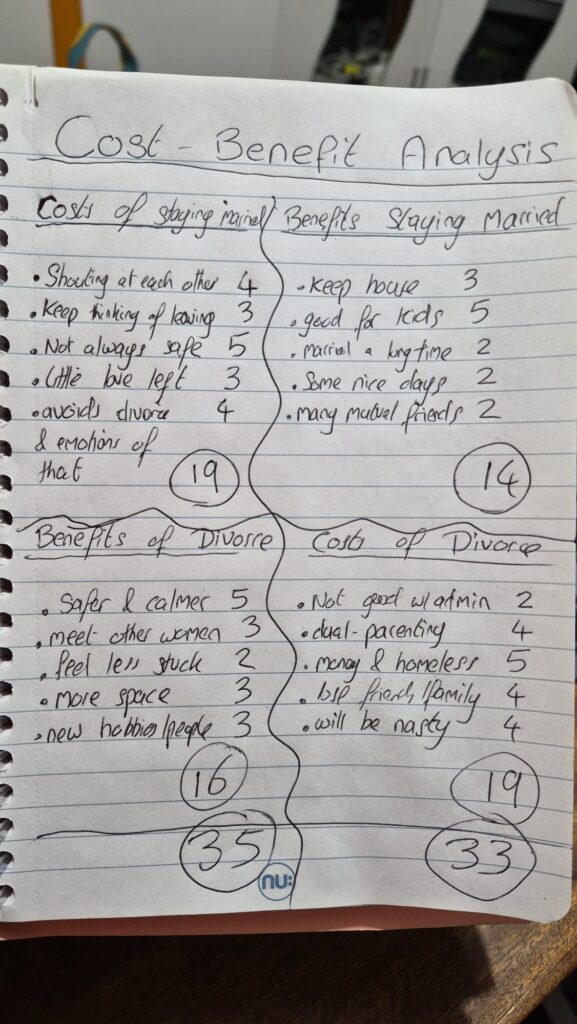
1. Write it down
Split a piece of paper into 4 quadrants and you can either use this Skill if you are ambivalent about starting the process of change and recovery, or if the urge is on you to use:
Cost of Addiction Benefits of Addiction
Benefits of Recovery Costs of Recovery
2. Come up with points for each
Costs of Addiction
–
–
–
Benefits of Addiction
–
–
–
Benefits of Recovery
–
–
–
Costs of Recovery
–
–
–
Take some time and think of some points for each quadrant. You don’t necessarily have to have the same number of points for each quadrant, just set a timer for 10 minutes or so and write out as many points as you can think of for and against using/recovery.
3. Score each point
Costs of Addiction
– 5/5
– 4/5
– 2/5
Benefits of Addiction
– 2/5
– 1/5
– 3/5
Benefits of Recovery
– 4/5
– 5/5
– 3/5
Costs of Recovery
– 2/5
– 3/5
– 1/5
For each point that you’ve put, rate them out of 5 – with 5 being very important to you, and 1 being not very important to you.
An example of Costs of Addiction may be “My relationship will break down if I keep getting drunk and being the way I am” which is very important to me, so I rate it as a 5.
A Benefit of Addiction could be “I really like the taste of beer, whereas 0 alcohol tastes watered down” which is less important and I rate as a 5.
A Benefit of Recovery might be, “I’d get to spend more time with my children as they tend to be in bed by the time I get back” which is fairly important to me so I rate it as a 5.
A Cost of Recovery might be, “I don’t like doing groups because I feel awkward and don’t know what to say” which I rate as a 2.
4. Tally it up
Costs of Addiction
– 5/5
– 4/5
– 2/5
11
Benefits of Addiction
– 2/5
– 1/5
– 3/5
6
Benefits of Recovery
– 4/5
– 5/5
– 3/5
12
Total: 23
Costs of Recovery
– 2/5
– 3/5
– 1/5
6
Total 12
You can add up each quadrant or just compare the left side (recovery) vs the right (staying or acting on addiction). In this fictitious example, where I haven’t actually put points, recovery is very much winning (23 to 12) which demonstrates that this is the better choice, even though there will be things that are uncomfortable about it.
If you find your scores are fairly balanced for both decisions, then that can validate why you feel so ambivalent about it. This isn’t DBT, but if you look at the Stages of Change model of Addiction, most of our recovery is spent thinking about it, planning about it, and being ambivalent before we’ve even actually stopped. So, a fairly equal score validates the ambivalence.
If the numbers are similar, I also tend to advise that whichever choice we make is uncomfortable, so the best option is to choose and accept one side because the indecision will be more painful than actually choosing recovery or addiction.
Benefits of Cost-Benefit Analysis
- Urges are more emotive or impulsive, and doing this is more rational and it can help us to have an objective overview. It’s also something that’s much less subjective than a craving. We can also revisit it, or talk with our sponsor or others about it
- It takes a bit of time to do – at least 10 minutes, which is longer than a craving and so if we’re using it to not act on a craving, even though we’re doing it open-mindedly and not decisively, we are less likely to act on our urge.
Clear Mind
Our final scenario was feeling as though we are a bit like Dr. Jackal and Mr. Hyde with two parts of us, and our inner addict tripping us up unexpectedly when we’re trying to make progress, and the last skill is called Clear Mind.
Dialectics
The name Dialectical, in Dialectical Behavioural Therapy is a bit odd, isn’t it? You don’t often see it, but you may have seen the word dialogue (a conversation between two opposing views to read an agreed middle grounds) which is exactly what Dialectics is about. DBT was named Dialectic BT because it is simultaneously validating and accepting someone, as well as giving them the skills and challenge to change.
These mirror 12 Steps, where Step 1-3 are about admitting powerlessness over our addiction and you cannot control it, then 4 onwards are about taking accountability with a moral inventory, amends, & service. It’s both accepting that you cannot control your addiction, as well as taking steps to address it.
One of the main categories of skills in DBTa is Walking the Middle Path. How two things can be true at once, rather than the black and white thinking or splitting that are symptomatic of BPD. In this case, being both an Addict, as well as in Recovery. In 12 Steps, people start a meeting saying, “hello, my name is Simon, and I’m an alcoholic”, even if they’ve been clean for a decade. They are simultaneously clean, as well as having that addictive capacity for compulsive substance misuse.
Wise Mind
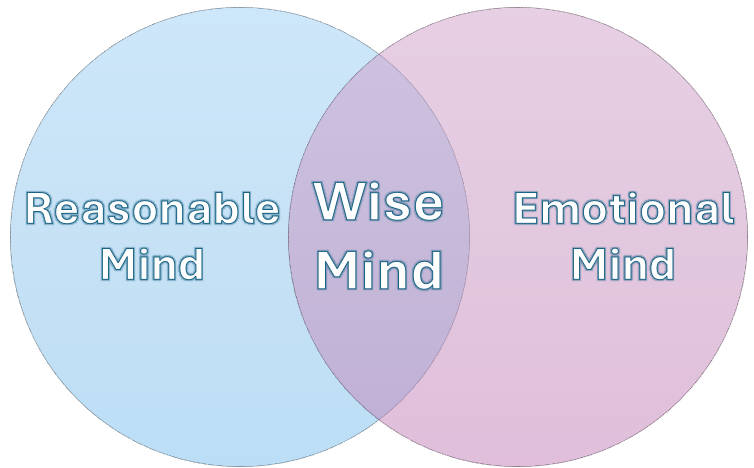
The Venn for Clean Mind may also remind you of Wise Mind, if you’re familiar with DBT. Not trying to be overly in our Emotional Mind which can be more impulsive and urge driven, but neither too Rational – disconnected from our feelings and others. Rather we are mindfully taking the best of both aspects in Wise Mind.
Clear Mind
In Clear Mind, we again have 2 categories that overlap: Clean Mind, Addict Mind, and Clear Mind.
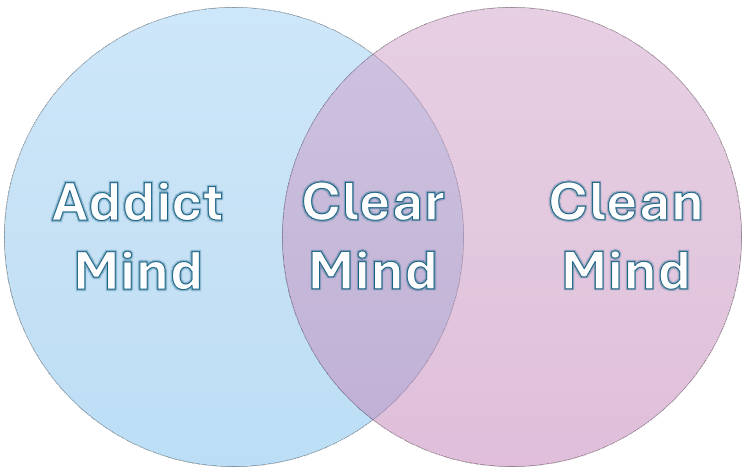
Addict Mind
Ruled by our addiction where much of our time, purpose, energy, thoughts, & feelings are all fuelled by addiction. We are much more emotional and impulsive, led by cravings and urges rather than being led by any kind of recovery.
Clean Mind
A point where you say to yourself that “I am fixed, I don’t have an issue with addiction anymore”.
The problem is that clean mind is naïve and doesn’t recognize the dangers of relapse which are symptomatic of addiction. Clean mind gives up on the skills that we’ve discussed earlier. It doesn’t think about cost-benefit, it doesn’t burn the bridges, and it isn’t proactive enough to even notice the urges, let alone surf them.
Triggers and urges are a natural part of addiction. I like to talk about addiction a little bit like having an allergy: if an alcoholic drinks alcohol the allergic reaction is that they cannot stop. Pretending that we are not an addict is being in denial. In denying your addiction, you are denying your vulnerability. Then when the triggers come along, which can often be years down the road with stressful, losses, burn-out etc, you don’t have the resilience, the reflectiveness, the resources, the skills that you are actively practicing so are at a high risk of relapse.
Some examples of Clean Mind thinking include: “I’m clean now, so I can go to that work party at the club”, “It was heroin that I was addicted to, so it’s fine for me to buy a bit of weed from this dealer”, “I’m going to go to the wake” (without risk assessing how much booze will be there or the impact of your grief).
Clean mind is thinking we are invulnerable and it’s an incredibly risky place to be
Clear Mind
Is a healthy balance of both sides of our Venn Diagram. You’re able to enjoy success and live a fulfilling life, but you are fully aware of your vulnerability. You know that you are an addict, and those old bridges that push you towards ineffective behaviour get rebuilt very easily.
You are practicing skills.
When urges and cravings come along, you’re not shocked by them and you certainly don’t judge yourself or think that you are somehow relapsing if you have a using dream, for example.
You are compassionate and loving to yourself.
You have support networks.
You are proactive rather than reactive, and you are fully aware of the fact that you could very easily relapse back into a destructive pattern of addiction.
Clear mind, that in between stage, is the reality of what sobriety looks like – radically accepting that you are an addict and not recklessly forgetting the risks.
Summary
- Cost Benefit Analysis is a great skill to use if you are unsure whether you want recovery, or if you’re finding an urge is on you and you’re weighing up whether to use.
- Use the Bridge Burning Skill once you have made a choice towards sobriety to remove triggers that will pull you back into addiction, getting accountability to stick to it, and build new bridges to live a fulfilling life.
- When an Urge or Craving is on you, it’s a normal part of recovery and not something to be alarmed of. It will only last for 7 minutes, and instead of resisting it, choose to observe the wave without judgement using the Urge Surfing Skill, rather than resisting it, using on it, or white knuckling your way through.
- True recovery balances a fulfilling life worth living, whilst radically accepting the reality of being an addict. The Clear Mind skill walks the middle path of these, acknowledging and accounting for vulnerability and is the strongest place to be.
Outro
My name is Simon, I’m a Person Centred Counsellor who works online or face to face in Oxford. My approach blends the empathy and acceptance that PCC is known for, alongside psychoeducation and skills drawn from approaches such as DBT. I have over 12 years’ experience working in the homeless sector, 6 of which were facilitating groups for folks who have come out of rehab, and I’m 2.5 years sober.
If you’re looking for counselling, do get in touch (simonlistening@protonmail.com) or if you’ve enjoyed this article, do check out some of my other articles for topics such as Mindfulness, DBT, Addiction, Grief, and Neurodivergence.
Simon is a Person-Centred Counsellor in Oxford working remotely and in person. He has lived in the county his whole life, and the city for almost 20 years. He appreciates the beauty of the city, nature, and connecting with people to help bring about meaningful change.
He is also a geek – who gets tremendous joy from gaming, crafting, cosplay, and creativity