
DBT for Impossible Decisions
You’re facing a tough choice in your life that is leaving you stuck ruminating in worry, and very much overwhelmed in your thoughts, feelings, and the sensation of panic. Either choice feels like a loss, and you don’t know how to progress.
Some examples could include:
Leaving a faith that you no longer believe in and misaligns with your identity, but you have good friends in the congregation and don’t want to disappoint your family.
Leaving a marriage that has turned sour, or even slightly abusive, but it will be more than just painful; it will cause you to split the parents of your children and leave you financially destitute.
You’ve signed up to a one year contract with your work, but one month-in, have found the role highly stressful and the job doesn’t align with your ethics or values. You want to leave, but are stuck for a year, and the pay & status is reputable.
All three of these are examples of what feels like impossible decisions, choices that we could ruminate and worry around because whatever direction we choose sucks.
This article is for you, It’s about trying to manage these choices that feel impossible using a skills-based approach to therapy (with a bit of psycho-education) called Dialectical Behavioural Therapy (or DBT).
Skills Summary
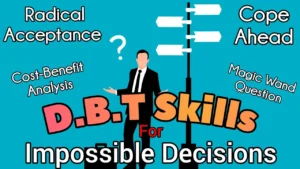
I’m going to teach four skills that can help you deal with these impossible choices, and each have their own merits and uses:
Cope Ahead & The Magic Wand Question
Both Skills address the fear we might feel in advance of a choice by realising that it’s not the end of the road & that there will be options we can use to progress afterwards.
Cost Benefit Analysis
Which can take something that feels quite overwhelming for our Emotional Mind and breaks it down so we have got numbers on either side. This stops the choice feeling quite so emotional and makes it a bit more cognitive, which makes it easier for us to make a Wise choice.
Radical Acceptance
Used when we don’t really have much choice or influence over a decision so choosing to accept it, and stop putting our emotional energy and time into trying to change or resist it.
Cope Ahead & the Magic Wand Question
If you have ever done an improv class or you’re into tabletop role playing games like Dnd, you’ll be very familiar with the ‘And Then’ question. Imagining ourselves in a situation that is highly challenging and thinking about what it is that we might do to progress: to ‘Cope’ ‘ahead’ of time.
Worrying about a situation and incessantly replaying what will happen and how it will be awful and overwhelming can feel like we’re being productive, but it isn’t actually getting us anywhere and we’re taking the payout of feeling productive without actually changing or decide by instead worrying . The irony is that worrying in the long term can bring more pain and suffering than the painful decision itself.
If you’ve done any CBT, you might have heard of Catastrophizing (thinking about the worst-case scenario) as a Cognitive Distortion and bad thing to do. The reason is, that Catastrophising stops at how terrible the choice will be which reinforces avoidance of it. Cope Ahead (in DBT), flips this on its head. It allows Catastrophising but then looks beyond the ‘catastrophe’ which dampens down the dread, fear, and panic that catastrophising brings. Instead, it imagines what we would do if we were in that situation, facing the thing that is hard for us. If the thing that you’re putting off actually happened to you, how would you cope? What would you do? What would the next step be?
Cope ahead is a great way of bringing hope to hopeless situations, and we can apply it outside of Impossible Choices for example we are about to be bereaved – it would be truly awful, but what could we do to cope?
Write it Down
Like all good DBT skills, there are steps for how to Cope Ahead. The recommendation is to write these down. There’s something about having a pen and paper that makes things a little bit more real and concrete, slowing our busy worrying brain down so we can process it. Plus, we can look back on it if the dreaded situation happens and draw on our plan when we’re struggling.
How to Cope Ahead
These are our 4 steps for Cope Ahead:
1. Describe the Situation
Describe the situation by writing it down on a piece of paper, or note-app on your phone. Describe the impossible choice, any thoughts that arise because of this choice, and feelings or fears that are there.
To using our first example, of leaving your religion, you may say
“I have been a Christian for many years, but that conflicts with my sexuality and I don’t really believe it anymore. But I have many friends that I have met in the church and my parents are very Christian and I worry about disappointing them and losing all my friendships if I distance myself from the faith.”
You’ve talked about the situation, how it conflicts, why it’s an impossible choice, and and the consequences that might be there from making that choice in your thoughts, feelings, and relationships.
2. Think about Skills or Problem Solving
Think about some problem-solving skills that you could use to cope with this choice.
If you were doing a full DBT program, you will likely have lots of skills that you can draw on
– Interpersonal Effectiveness: how to how to manage your relationships and talk with people.
– Distress Tolerance: when things feel like they are big and overwhelming, because those feelings are likely to come up if you were to action leaving the church or staying and feeling compromised.
– Emotional Regulation: how to live a balanced life, to sit with uncomfortable feelings, and to be able to shift emotions when they’re feeling unhelpful or disproportionate.
– Mindfulness: boosting self-awareness for how we can be present with the discomfort in the present-moment.
If you aren’t familiar with DBT skills, that’s also fine. Instead, for this second stage, just think about what options you could have – this is still Problem Solving. Plan ahead, and think about what you could do when difficulties arise and what those practical plans might be to help you cope.
3. Imagery
Imagine being in that situation where we have made the impossible choice and are facing the consequences. We were dreading it, but now we’re imaging being there & imagining what we are doing to cope.
Some people are very visual thinkers with minds that play like a video. Others think in images. Still others think in words or narrative. Visualisation approaches are more tailored for folks with visual styles of processing, but you can use imagery in whichever way you think, and no thinking-style is wrong or inferior. I mentioned earlier, that folks who like DnD or Improv acting may quite like this stage. Imagine that you are actually faced with this Impossible Choice, that you have chosen an option, and now you are Coping (or even thriving) by facing the consequences and making those choices in step 2 that will help you cope. You can do this visualisation deeply if you choose – actually picturing how it might feel to be in that choice rather than dreading it as too much (like in Catastrophising).
4. Rehearse
Practice the DBT Skills or Problem-Solving Solutions you came up with in Step 2. If you were in a play, you wouldn’t be learning your lines when the show starts; in the same way you practice skills before facing a challenging situation, so that when the situation hits you, they feel second-nature and possible (even in fight or flight) – you are competent at those stage 2 Skills when the catastrophe hits.
The Magic Wand (or Time Machine) Question
This isn’t a DBT Skill, but similarly to Cope Ahead, it looks beyond the choice as a Catastrophe and pictures a positive blissful outcome. If you’ve had counselling, your counsellor may well have asked you the magic wand question; phrasing it along the lines of:
If I flicked a magic wand that could fix this difficult situation for you, what would that look like? What might change in yourself, your relationships, and the environment?
Or
If I had a time machine and could take us forwards in time a few years to an ideal future where this situation had resolved and life was better for you, what might that look like….?
The magic wand or time machine can help give a bit of clarity on what we are actually scared of or dreading which can inform what we are trying to Cope Ahead with. For example, with leaving our religion, it may be something deeper that we are dreading such as: being a disappointment to our parents, confirming a change in our identity, being alone, being ‘sinful’, or failing somehow in faith.
Cost-Benefit Analysis
This sounds very fancy and difficult but essentially it is a glorified pros and cons list where we are scoring each thing that we come up with and that helps us to have a numerical value on whether we should do this thing or not do this thing.
Our second ‘Impossible Decision’ example was leaving a slightly abusive marriage that has turned sour is what we’ll use in teaching this Skill.
Cost-Benefit can also be very useful if we are looking to change a behaviour that we recognise as ineffective yet has helped us to cope e.g. if we are addicted to alcohol.
How to do a Cost-Benefit Analysis
I attach an image below of the completed Cost Benefit Analysis of leaving this fictitious marriage. You can just copy and adapt it, but I’ll also write out the steps.
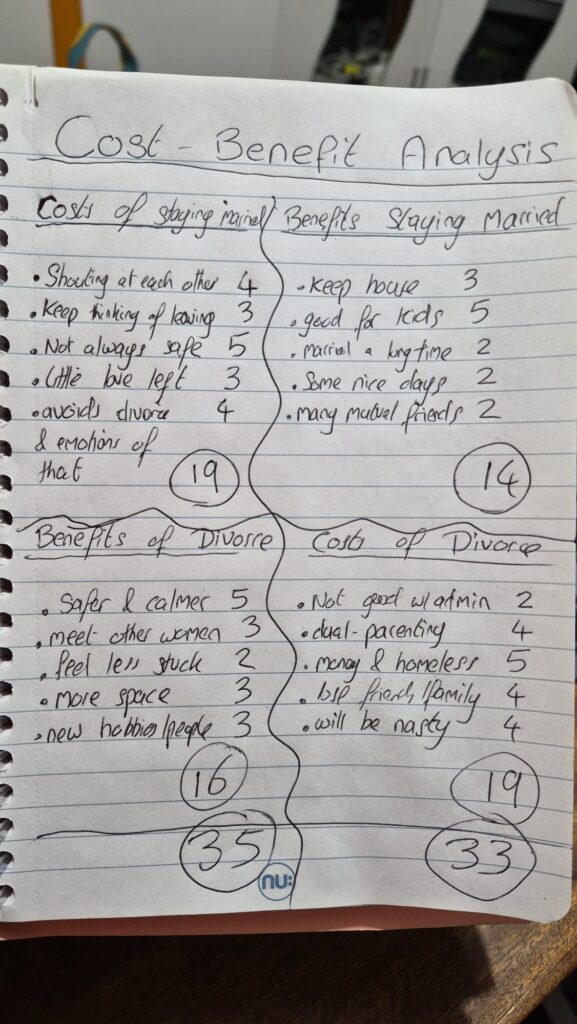
1. Draw a 2 x 2 Grid
In the Top Left box, put the Costs of Staying in an Activity
In the Top Right box, put the Benefits of Staying in an Activity
In the Bottom Left box, put the Benefits of Changing the Activity
In the Bottom Right box, put the Costs of Changing the Activity
2. Come up with Points for Each Box
Think about points to put in each of the four boxes. These can be very practical things e.g. ‘I don’t know how to file for divorce and need to learn that’. They can also be more subjective things, for example ‘I would feel less stuck’. Feel free to spend as long as you’d like on this, and dig deeply into feelings, thoughts, the situation, relationships – anything you’d like to put in each box. Be unfiltered, in that you don’t have to show this to anyone.
In my example, I have put 5 points in each box, but you are free to put as many as you’d like if it’s an accurate representation of the costs and benefits of a decision.
3. Put a Number on Each Point
For each point, rate them on a scale of 1-5 where 1 is not very important to you, and 5 is very important to you. This more cognitive task can take us out of Emotional Mind and help us to realistically and fairly measure each of the points we have put on our analysis. If at this or any other stage, you want to adjust it, that is also okay – you can add more points or delete and merge points.
4. Add Them Up
Add up all the values for your points (calculators are totally allowed). This will give you a total score for each box. You can then compare the total scores for the Left and Right Columns which will give you a way of comparing making the choice or choosing to stay.
Sometimes one column will be a much bigger number than the other. This can be really soothing because then you’re getting a lot of validation that one choice, even though it’s uncomfortable and the decision still feels impossible, is much more obvious than the other.
In my fictitious example, the scores were close together (35 vs 33).
This can also be helpful. It says that that either choice is okay if we use Cognitive Reframing to examine our interpretation:
> One interpretation might be: “whichever I choose is terrible, so I can’t make the choice and this analysis was pointless”.
> Reframing could instead say: “The numbers are similar which validates why I have found this decision so hard. Because the scores are similar though, neither decision is wrong and so I should simply choose one of them because the suffering of worrying is worst that the inevitable pain I will suffer from ripping off that plaster” and making a choice.
Radical Acceptance
The final skill that we’re going to be covering when making an impossible decision is Radical Acceptance. This may be the easiest of the three to name and teach, but is by far the hardest to practice and we often have to continually Radically Accept in layers.
Radical Acceptance acknowledges that we put an awful lot of energy and emotional resources into trying to change things that we cannot necessarily change. Rather than trying to make those things be any different, Radical Acceptance acknowledges that we can’t change them and so accepts them by embracing our present moment reality – including the difficulty and all the feelings and suffering it entails. This can be really liberating because we are no longer putting resources into something that we cannot change.
Radical Acceptance is not Radical Approval. Many people who learn DBT have BPD (EUPD), which is often caused by repeated developmental traumas such as abuse. If we are an adult with an abuse history, we cannot change what has happened in the past. It wasn’t right or fair that it happened to us, and it is human to rage and be hypervigilant to protect ourselves from it happening again. We aren’t saying we welcome it or are glad it happened, nor are we condoning it – Radical Acceptance is saying it happened, there’s nothing that I can do to change this, and so I am going to accept it. I’m going to give up spending my resources into trying to block it out.
Our third example of an Impossible Choice was the stressful job that doesn’t align with our values but the pay is good and we are stuck there for a year due to our contract. In a year we can change this and can Cope Ahead or do a Cost-Benefit on changing job, but it is futile spending the next year resisting our reality and trying to change what we cannot change. Instead, we are going to choose to Radically Accept that we are staying in this job – choosing the unpleasant job rather than resisting our reality and experiencing angst and misery.
(Note – if you are considering a career change, do check out my article on Finding Your Calling which has practical tips including working out what your values are).

How to Radically Accept
This is much less if a step-by-step DBT Skill and there are different angles you can approach this from, but I suggest the following steps:
1. Can you Control the Situation?
Work out the extent to which you can control this Impossible Decision or unpleasant situation you are trying to Radically Accept. Generally, there are three categories:
Completely Within Your Control: In which case change it using problem solving, skills, and accepting responsibility for the situation.
Within Your Influence: Needs a blended approach between accepting it and seeking to change it by realising the extent to which changing it is possible. A key message in dialectics (DBT) is that two things can be true at once, so a situation can both be within your control and not within your control so you are accepting it whilst also changing it.
Not within your Control or Influence: like the next year in this unpleasant job, you can’t change it, so you need to Radically Accept it. This also often applies to things that have happened in our past. For anything in this category, Radical Acceptance is the skill we need.
2. Become Aware of Powerlessness
Become aware of the fact that there’s a situation that you are resisting and cannot particularly change.
You could do that using the mindfulness skills to boost self-awareness.
You could alternatively think about a situation that’s causing you to have quite a lot of strong thoughts and feelings and write out specifically what that situation is.
3. Causes
Look at the causes of that situation, the things that have contributed towards it, that the facts of the matter. So, what happened that caused you to get stuck in this career that you you’re stuck in for the next year?
4. Feelings
As you’re doing this, notice any feelings that are coming up. Maybe a sense of anger or lowness. Just notice the feelings that are there because you’re getting a holistic idea of your resistance to accepting it.
5. Radically Accept it
Do some actions that aid with Radical Acceptance:
- Opposite Action:
Use the skill of acting in a way that you might act if you were to accept the situation that you are resisting. ‘Half-Smile, Willing Hands’ is one such skill where you smile and put your arms out as though accepting the situation. There may also be some physical ways you could think, feel, or behave that would be typical of someone who had accepting the situation. Do these in in behaving this way, you will begin to radically accept. - Imagery:
Using similar imagery to Cope Ahead, imagining what it might look like if we made that choice to Radically Accept our situation. Imagine embracing the situation and yourself feeling peaceful with it. - Mantras
Sayings that you can repeat to get you back-on-track to acceptance. An example might be the Serenity Prayer that is used a lot in AA.“…grant me the serenity to accept the things I cannot change, courage to change the things I can, and wisdom to know the difference”
Accept in Layers with Compassion
I’s a very easy thing to talk about Radical Acceptance, but it’s hard to do and tends to happen in waves or layers. You may accept things on paper like with a contract, or rationally by writing it down or deciding. This feels like the skill is done, but I find it’s more an ongoing process where strong feelings or pangs of emotions come up that are contrary to acceptance. You will doubt it, ruminate, and resentments might form. If you have been traumatised, you may accept it but still get visceral reactions in the body or flashbacks. Radical Acceptance is a process that cannot be rushed, rather than a switch we flick. It’s like a commitment, a discipline, and something we have to continue to choose. Just as two things can be true, we can compassionately be Radically Accepting whilst at the same time experience a lack of acceptance. Remember, accepting isn’t condoning or wanting the situation, it’s giving up resisting it in order to find peace.Invest that Energy Elsewhere
Many of the Emotional Regulation Skills in DBT aren’t about focussing on the emotions we experience, but about trying to invest and balance other areas of our lives which feed into positive emotional experiences. Instead of resisting your situation, acknowledge how much it sucks, and invest the energy you were using to resist it into other aspects of your life that nurture you. Imagine how liberating that might be – to instead of fighting what you can’t change, you used Radical Acceptance to spend your resources on hobbies, health, friends, family, development? How nice would that be? There are some wonderful, wonderful benefits of Radical Acceptance.
Outro
Impossible Decisions can feel debilitating and beyond our control, but DBT Skills can be used to problem solve and give us agency over them which can be invaluable when facing an Impossible Decision.
Thank you for reading this, and I think of you and hope these skills have been of use in facing this impossible situation.
My name is Simon. I am a counsellor based online or or face to face in Oxford. My specialism, the thing I work with most, is people who are stuck in patterns of self-blame and that comes up a lot in things such as divergence, bereavement, & addiction.
If you would like to work with me, then do get in touch with me at simonslistening@protonmail.com
If this has been helpful, you may enjoy some other articles videos that touch on similar themes or skills covered within DBT by clicking on the links below for:

Simon is a Person-Centred Counsellor in Oxford working remotely and in person. He has lived in the county his whole life, and the city for almost 20 years. He appreciates the beauty of the city, nature, and connecting with people to help bring about meaningful change.
He is also a geek – who gets tremendous joy from gaming, crafting, cosplay, and creativity