

Memory Box for Grief
This article is about building a memory box for somebody who has died. A Memory Box is a way that you can connect in with your loved one and helps with the grieving process.
In the first part of this article, we will build a Memory Box (the one I am building is remembering my Nanna) and I’ll make some suggestions about how to build it and what to put inside using the senses and imagery.
In the second part we’ll talk more about the psychology of why memory boxes can help us grieve. We’ll do this with a summary of benefits, and support that with both Bereavement Theory and some DBT Skills.
Contents
Building the Box
The container that you use for the memory box doesn’t particularly matter. In my example, I am using a shoe box – but you may want to use a more decorative container. It doesn’t even need to be a box; it could be a bag, shrine, wardrobe, or even a whole room that you fill with items connected to the deceased. You could also create a digital memory box, for example by creating a folder on your mobile phone where you store photos, videos, messages, and music that helps you connect in with your loved one or a social media page or website about their legacy. For the purposes of this video, especially because it is based on the senses, I will be talking about a physical memory box made from a shoe box – something that you can choose to open or close.
Decorating the outside of the box
Some people choose to decorate the outside of the box. For them, it adds a sacredness to it that elevates it from a mundane shoe box and signifies that it’s an important touchstone to connect with their loved one.
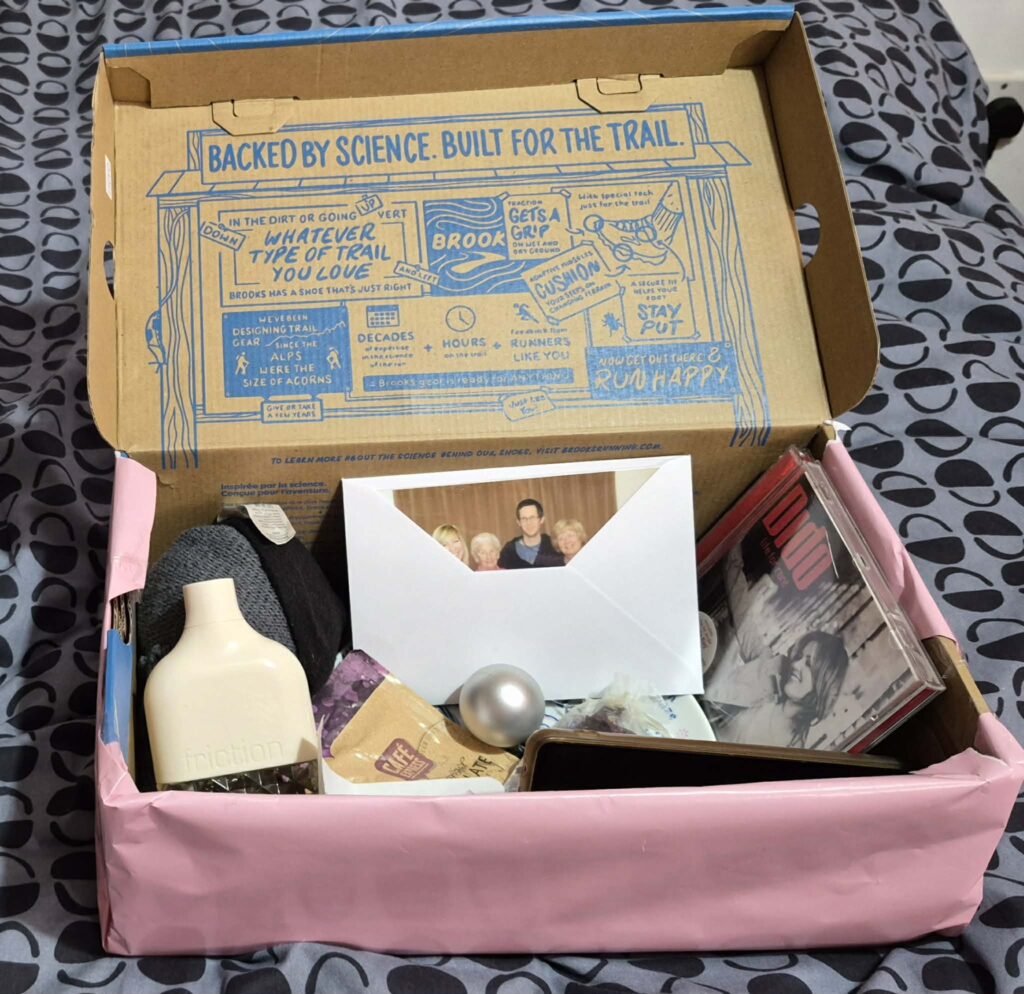
In my example, I am remembering my nanna (who died a decade ago, and it isn’t too triggering for me). She had a lot of pink in her house, and her favourite flowers were carnations, so I am wrapping the box in pink wrapping paper in memory of her. You may want to also pick a wrapping paper that reminds you off them, or print of images to decoupage the front of it. Feel free to decorate it in a way that is meaningful to you and the deceased.
Others choose to not decorate it on the outside (they may on the inside). They deliberately want it to look mundane because it makes it more private and contained. Imagine you store it under your bed and have wrapped it with an image that reminds you of them – that could be an unwelcomed trigger to grief pangs so you may choose to keep it as simple as possible to give you control over when you are or are not triggered into strong emotions related to their death. The decision to, or to not, decorate the outside are a personal preference and neither option is right or wrong.
Vision
Let’s start putting things into the box, and the first five categories of things relate to the senses because they’re a great way of connecting with memories. For the first sense, we’ll do vision.
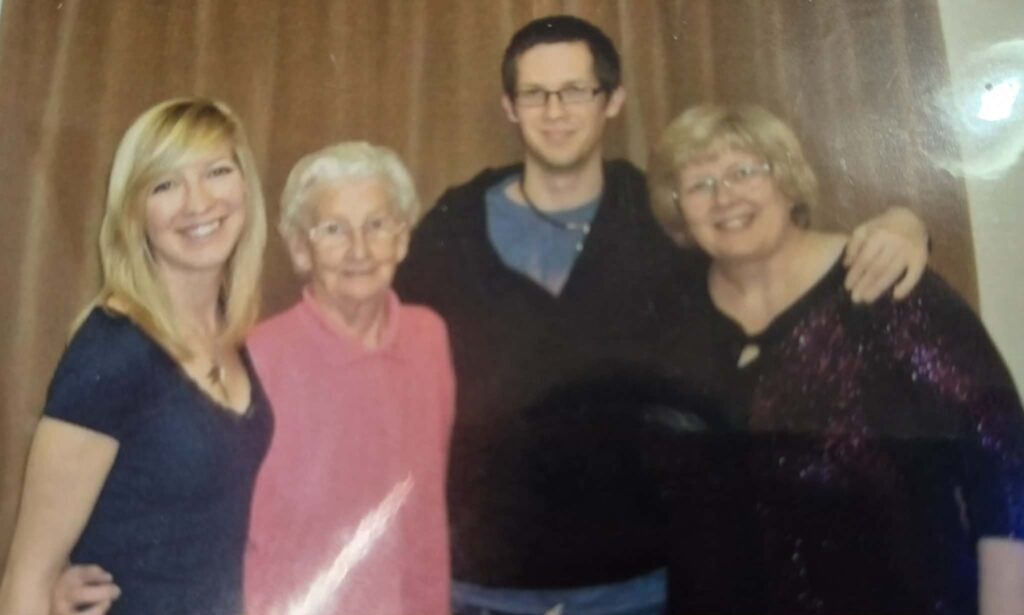
I’m putting a photo of nanna into my memory box, which had some lovely memories for me – it was the last photo we have together before she went into a care home. Photos can be very evocative, so I put this photo into an envelope. This gives me an extra level of control over which items I see when I open the box and can help me regulate the intensity of the memory box (I can choose to engage with the photo, or something less triggering like the soothing tastes we’ll cover later).
You could add photos both of them, and things that remind you of them (their home, a holiday you went on, an animal they had, or some nice memory). The point is that you can look at the object, and it will evoke memories that remind you of them, and combat any fears of forgetting them.
Smell
Olfactory senses seem particularly powerful tools for conjuring memories, so much so that trauma survivors often report being triggered by familiar smells. So for our memory box, think of a smell that reminds you of them or of activities and occasions that evoke memories of them.
In my memory box, nanna (being a woman of her time), very much liked potpourri and used to leave it in her bathroom to make it smell nice. My wife and I also quite like making confetti from dried flowers, and a sample of that with dried lavender (in a little drawstring bag) has a nice smell that reminds me of her bathroom and they way she’d have the potpourri in a little tray over the toilet basin. I’ve also included some perfume, which is a much stronger more evocative smell to trigger memories.
For you, there may be other smells that remind you of your loved one (maybe they liked a certain food, smoked a particular brand of smokes, their deodorant or perfume, a fresh linen smell, or certain scented candles). Consider scents that remind you of them, and there may be different grades of strength (with the perfume being intense, and the potpourri being more soothing & subtle).
Hearing
You may have a recording of your loved one’s voice, a video where they are speaking, or an answering machine message e.g. from their mobile phone when you call it which you may want to pop on loudspeaker and record. A lot of bereaved people fear forgetting the particulars of their loved one – especially things like the sound of their voice, and a sample of that can be reassuring.
In my example, I have no recordings of her voice (though I still recall her thick Berkshire accent) but am instead using music to remind me of her. I’ve put in a CD (Dido, White Flag) that I was listening to more when she was alive and there are some quite sad tracks on their that evoke tears in me. I’ve also written down the name of a song (Candle in the Wind, a song that played at Princess Diana’s funeral and she liked Princess Di). If you have a physical copy of music, put it in, or otherwise just write down a song title and you can find it (e.g. on Spotify or YouTube).
Music can be very containing for grief. Not only does music help exaggerate and express feelings, it also has a fixed length. So I could put on Dido’s “See the Sun”, have a listen to it and a good cry, then choose to listen to it again as many times as I want. People often report fearing to allow themselves to really feel the pangs of grief, for fear that it will never cease, and a song (only lasting 5 minutes or so) can be a great container for that. You can choose any songs, a song personal to you or them, maybe something that played at their funeral (Abide in Me), or maybe you used to visit the beach with them and want to find some calming background music of the waves and seagulls squawking away to connect with them.
Taste
Taste is a combination of several senses – the taste buds on your tongue and mouth, the smell of the food or drink, and the sensation of chewing; all of this is a brilliant sensory tool to connect with your loved one and spark memories. I’d encourage you to eat mindfully (especially if comfort eating is a risky behaviour for you), it’s less about the eating and more about savouring the flavour to remember them.
I’m adding hot chocolate powder to my memory box. Nanna used to make a really good hot chocolate. When mom and dad made hot chocolate, it was a bit bitty where it hadn’t dissolved and they’d done it in the microwave with water and milk, whereas nanna did the good stuff – pure milk heated up on the gas hob with sugar and it tasted wonderful.
She also used to help out around the house when I was a child when mum was struggling, and when she’d come over to do chores, she’d bring me a handful of toffees in a little paper bag which was a right treat for a young lad. In filming this, I didn’t have any toffees, which is useful because it emphasises that your Memory Box isn’t a finished thing, you can always add other items to it over time (like I could buy toffees when I next see them and add a few to the box).
So think of food, drink, and other tastes (e.g. gum) that you could add to your memory box to remind you of your loved one. Consider also the texture of the item, and just make sure it isn’t too perishable (e.g. don’t put fruit in there like a banana, but you could find banana flavoured sweets).
Touch and Movement
This is several senses like touch, pressure, vestibular (balance) and proprioception (movement of limbs).
We may want to include a reminder of how the person physically felt. My nanna (for example) had quite wrinkly skin, and though I can’t include that I might include a stim toy like flour in a balloon that has a similar sensation to her skin. Perhaps the feel of your loved one is too hard to recreate with an object, so a pad of paper could be in there and you could write about their touch.
You might want to think about the way the person physically interacted with you. There can be a sadness is doing this, but maybe you want to hug yourself if they put an arm around you which can be quite soothing. If it was your sexual partner (without being too crude here), there may be ways of connecting in that way and remembering them. In British culture, touch is often reserved almost exclusively for nuclear family, and the loss of our loved one can leave us quite touch starved, so recreating that (through imagery or self-touch like hugging oneself) can help connect with that lost sense of touch. If you’ve lost a young child or a baby (pre or post natal), it may be nice to keep a blanket you had for them and even to have a weight in it so it feels a bit like holding them and using that sense of weight to connect with them.
It may be that there is an object that you can use the sense of touch or movement to connect with them. I’ve put a pair of knitted gloves in because nanna liked to knit – they’re not gloves she actually knitted and with that, it’s okay if you don’t have their original stuff, the aim of the box is to rekindle memories and connect with them, not to perfectly be their stuff. There may be other clothing that reminds you of them that you could hold or stroke.
It may be you want to use movement to connect with a memory of them. Nanna was very into ballroom dancing as a young woman (which is serendipitously where I met my wife) so maybe dancing round the room after opening the box reminds you of them. Perhaps they loved football, so you might have a ball in the back or hacky sack and do some keepy-ups to remember them by moving. Nanna would take me to the park as a boy, maybe a picture of the slides there and imagining being there could also use movement to connect?
It may be that you physically want to put some of your loved one in the box. In nanna’s generation, they would often keep locks of hair from when they were a baby. It maybe you have some of their ashes, or dried flowers from their grave. Something that is directly their body, or a reminder of their body that helps you feel like they are there for you in the memory box.
A Phone
A mobile can contain media such as photos, videos, audio and other reminders of them.
It may actually be their phone. You can connect with them by reading their messages from you or looking through their photos. If you’ve moved it to a pay as you go contract, you can also physically text them or leave them voice messages or even speak to them if you go to another room. I know they can’t text back or reply, but having their phone can be a powerful tool in your Memory Box.
Sentimental items
I’ve included a plate for my Nanna and Grampy’s 60th anniversary which is an amazing accomplishment (even though I never met him). Likewise, there may be items that are sentimental and you’d like to keep all of it or a part of it (e.g. a clipping from their wedding dress). Any item that feels sacred, sentimental, or important to them/you could go into the Memory Box.
Items that use imagery
This is any other item that you can use as a touchstone to connect in and remind you of them.
In my example, nanna was very into Christmas and that festivity over hers was a big deal so I’ve added a bauble to remind me of that. You can think of any other items that remind you of them or act as aid memoires.
Summary
I’ve written the above guide for how to build a Memory Box using the senses and imagery, but remember that it’s your box – make it work for you in a way that helps you grieve and connect to your loved one. There isn’t a wrong way to make it, and it doesn’t need to be complete or perfect (e.g. if you don’t want to include one sense, that’s totally fine).
Completing the box has some other benefits too, for example if you’re left with a room full of items from the deceased, making a memory box may relieve guilt from throwing away some of those items.
When you’ve completed your Memory Box, you can put it in a safe place (e.g. under the bed) and get it out when you choose to on your terms.
Why Memory Boxes Work
1. A contained controlled space because grief is existentially beyond our control
A memory box is something that you can access on your terms, and fosters agency in the face of overwhelming uncertainty
2. A way of locating the deceased
it gives you a place to visit them which can provide a slight sense of closure, knowing where they are and having a location to connect with them
3. A tool for creating continuing bonds
Unlike Freud’s idea of a cathartic severing of our attachment with the deceased, continuing bonds acknowledge that we have a relationship that continues with the person who has died. And a memory box is a way of being able to build, adapt and maintain those continuing bonds.
4. A safeguard against forgetting them
There may be aspects of the decease that we begin to forget or become fuzzy in our mind. A memory box gives us a way of sharpening our memory and helps combat that fear that we may forget them as our changes and grows over the years
5. A vehicle for emotional expression
what Freud would call catharsis, what other theorists might call grief work; pangs of intense grief that hit us emotionally and psychologically. It gives a way to engage with the death and express those feelings that characterise grief.
6. A somatic connection for grief
by somatic, I mean physically using the body and senses. A lot of modern therapeutic approaches integrate somatic practices.
Therapists often talk about the Vagus Nerve (the sympathetic and parasympathetic nervous system) but there are actually 12 Cranial Nerves (of which the Vagus is one, and the longest) and almost all of them are about sensing the world (whether directly, or indirectly e.g. eye movement). What I’m saying, is that we are very sensual creatures and using senses in our memory box is a more direct way of igniting and rekindling memories than just feeling or thinking about them.
7. A brief vacation from bereavement
A memory box can be used to either pretend the person is still alive, or as a break from life outside our grief in nurturing our continuing bonds. Grief is emotionally and psychologically exhausting and relentless. Using the box to create a mirage of them still being alive is a welcomed break to catch your breath and vacate from the pain of their death. We’re not in denial or gaslighting ourselves into thinking they are alive, but we are getting respite from the intensity of their absence.
8. A way to share about them.
You can talk to other people about the box, or perhaps even open it with someone else who is also grieving that person. Since making the memory box example, I’ve found myself remembering more about nanna and have shared little stories with my wife, so there’s also an indirect effect that doing grief work will make you more likely to share your experience.
Bereavement Theory
Do check out my other article on Theories of Bereavement as it goes into the seven bereavement theories I mention in a lot more depth about those theories and how they interact to help us understand the process.
Stage/Task Based Models
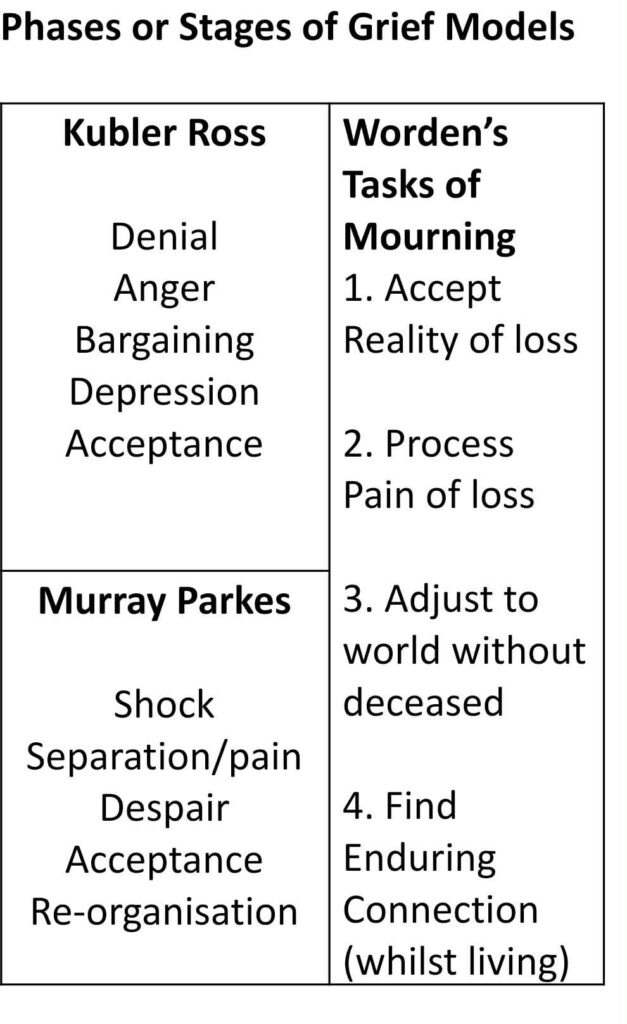
Above are three models which talk about stages or tasks you transition through:
Kubler-Ross’s Stages of Grief
Warden’s Tasks of Grief
Murray Park’s Stages of Grief
1. Emotions
Kubler-Ross and Murray Park’s model are quite emotion focussed, but stages like despair/ depression/ anger/ shock don’t quite do the intensity of those feeling justice. These are feelings that are very much overwhelming and at an intensity you may otherwise be unfamiliar with.
A memory box can be helpful irrespective of what we’re feeling. If we’re feeling angry at the deceased for leaving us, loneliness or despair at being on our own, raging against the world, deep in tears; using the memory box is a way of being able to engage those feelings using the objects within it
2. Accepting the Reality of the Loss
All three of these models describe a struggle accepting the reality of what’s happened. You may experience that as numbness, shock, depersonalisation (as though being a character in a game). We know it’s real rationally, yet it doesn’t feel real and the memory box can assist confirming the reality of the death. We can use the space to engage with their death whilst simultaneously connecting with them.
3. Reintegrating back into life
Warden talks about adjusting to the reality of a life without the deceased, Murray Parks about reorganizing our life, and Kubler-Ross about that mythical place of acceptance. In all of these we are talking about continuing our life and having a memory box can be a way of doing that while still having the assurance of possessing a means of connecting with them.
Continuing Bonds
Warden’s final point is about creating an enduring connection with the deceased. This opens up a whole theory called Continuing Bonds. Freud’s idea that we can sever our attachment with the deceased in a cathartic way doesn’t quite match up with the experience of bereaved people. We have an attachment with our loved one, which is why the grief hurts so much, and that doesn’t go away on death – just like we never forget the deceased (e.g. my nanna having died a decade back) our relationship with them doesn’t stop.
Tonkin’s model emphasised that grief isn’t something to ‘get over’. At first our grief may be characterised by deeply painful pangs of grief, and those pangs may always get triggered from time to time, but they get triggered less as time evolves. Bereavement isn’t a mental health issue to treat or a condition, it’s a relationship with a person. They die, but we don’t forget them; rather our relationship continues – beginning with it being characterised more by those pangs of grief and evocative feelings we feel and are unable to regulate without our coregulator, but as the years go on, we continue to foster our relationship with them and it can shift from pain to other qualities.
In writing this article, my relationship with my nan has been nurtured and I’ve remembered things I thought I’d forgotten. I can almost imagine how she might be talking with me as I write this. Using a memory box can foster an ongoing relationship with the deceased, irrespective of if you have any spiritual beliefs in the afterlife or not (even for staunch atheists).
Dual Processing Model
When we are bereaved, we painfully oscillate between the Loss Orientation (grief work and pain) and Restoration (adapting to a world without them and living life). This oscillation can be quite rapid and disorientating with strong feelings that hit us like waves that are hard to predict.
A memory box can soften that oscillation and spur us to think of other strategies and techniques to be able to connect with the person to in a soothing way. This can be even more so if we have a digital memory box such as on our phone or social media – something we can readily access to assure ourselves that they are still there.
DBT Skills
Dialectical Behavioural Therapy is a school of more psychoeducational therapy designed for people with more impulse control or intense uncontainable emotions. It was primarily focussed on DBT, then applied to other things such as addiction or working on other target behaviours. You do not need a DBT Full Program for a loss, but there are some DBT Skills that can be helpful as they’re about responding to strong feelings to soothe them or have more control over them.
Subjective Units of Distress are a way of self-reporting your level of emotional dysregulation out of ten. So 0/10 would be quite neutral and lacking in affect, and 10/10 would be very much overwhelmed (at panic attack level).
Wise Mind ACCEPTS
ACCEPTS is an acronym, a menu of 7 different mini skills we can use to distract ourselves when our emotional intensity is pretty high (maybe at a 7-8/10 [if you’re higher than this use TIPP]). The full acronym uses the following to distract with:
Activities
Contributing
Comparison
Emotions
Push Away
Thoughts
Sensations
And it’s the S on the bottom, Sensations, that we’re using the Memory Box for.
The trigger of our dysregulation is pangs of grief caused from missing our loved one. We are then using the senses (which connect very directly with the brain) to distract ourselves from the intensity of those grief pangs.
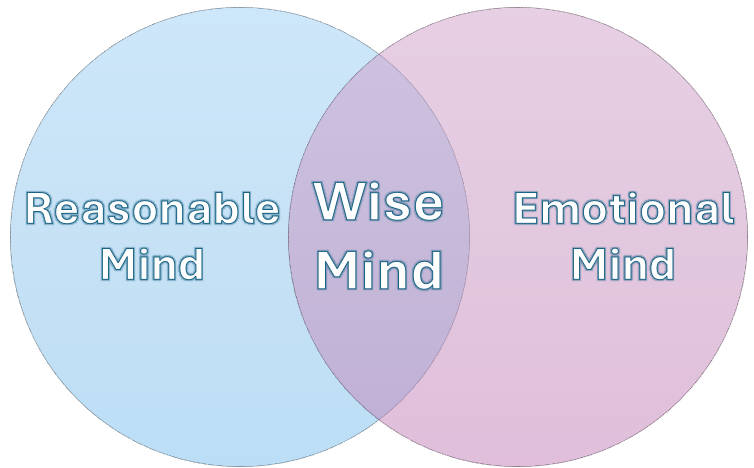
With our example Memory Box, this is where I’d be going for the perfume, a strong olfactory smell that distracts the overwhelmed minds back into wise mind by triggering memories of the person and very viscerally reminding me of their presence so providing relief.
Self Soothe with the Senses
At first I thought this was the same as the S in ACCEPTS, but there is a difference between Self Soothing emotional dysregulation and Distracting from overwhelming emotions. You’re more likely to use Self Soothe when you’re slightly lower down on your SUDs (maybe 5-7), more dysregulated than you can observe with your mindfulness skills, but not so much so that you need to interrupt the feeling with distraction.
Self-Soothing is being kind, lovely, gentle and nurturing to yourself and we can do that using the senses. The idea is that is reduces the risk of us acting in ways that can cause us harm from our emotion mind and is moving more towards wise mind.
Again, we are dysregulated because we are missing our loved one and are looking to soothe ourselves to connect with them and calm ourselves mindfully.
Vision: look at the photos or objects
Taste: enjoy the hot chocolate or tastes in your box that remind you of them
Hearing: put on the CD of music or listen to and observe their voice
Touch: hug yourself, touch clothing from them, act using motion in a way that reminds you of them
Smell: use a less intense smell like the potpourri to gentle connect, or perhaps just spray the perfume into the air lightly rather than into your skin and deeply breathing
Self-soothing can last as long as you’d like it to. Distracting is likely a fairly quick process, whereas self-soothing is something you might stay with for a while.
IMPROVE The Moment
Much like ACCEPTS, IMPROVE is a menu of 7 mini skills that we can use to either change our appraisal of ourselves, or of our situation to make catastrophise and things that we are quite powerless over a bit nicer. ACCEPTS and Self-Soothing can give a momentary relief from grief, but grief feels huge and endless, and IMPROVE just improves the moment.
Using our Memory Box:
Imagery such as some of the sensory tools or the photos/videos can be used to close our eyes and imagine being with them, like an adaption of the Safe Space Meditation. Imagine what it would be like to be with your relative
Meaning Making is a whole theory of grief, and can be empowering to derive meaning from the loss, such as knowing they are part of you and you are building connection with them using the box. The box meets this letter less though.
Prayer can mean speaking with them irrespective to whether or not you have spiritual beliefs, because talking to them and that act of connecting can help soothe and build continuing bonds.
Relaxation might include something like enjoying the hot chocolate or the music, you may even shift rooms for example having a nice relaxing warm bath whilst playing the CD or music from your box.
One Mindfully taking items out of the box one by one, or immersing yourself in the act of using the memory box without distractions such as having your mobile phone sending you notifications. Clock out some time to just spend with the box.
Vacation taking a break from what is hard in your situation, and that may be a break from the intensity of grief by using the box to create the mirage that they are alive, or a break from that Restoration Orientation by engaging with the loss through the box. The DBT manual suggests taking a break from the situation for up to a day, in grief, a break for even a minute can give us space to rest.
Encouragement can be used in much the same way that Prayer can be used to speak with them. Imagine what they might say back to you. We can be our own worst enemy and critic, imagining having not done enough for them or having unfinished business with the deceased. Perhaps considering all of this, they might say kind things to us, and encouragement is about imagining the helpful things they might realistically say to us in this situation if they saw us grieving using the box. You can use self-encouragement, or channel them to find encouragement (picturing them with their arm around you as you self-soothe by hugging yourself).
Outro
Below is a video from a series of 12 shorts that you can find in the Bereavement, Death, and the Existential Playlist that talks about the Top Tip to Grieving: Connect with your Loved One. Do check out the playlist for several videos on bereavement & how counselling can help

Simon is a Person-Centred Counsellor in Oxford working remotely and in person. He has lived in the county his whole life, and the city for almost 20 years. He appreciates the beauty of the city, nature, and connecting with people to help bring about meaningful change.
He is also a geek – who gets tremendous joy from gaming, crafting, cosplay, and creativity